
How to Plan Headcount and Payroll Timing in a Startup Financial Model
Use AI tools, contractors, and professional services to keep the MVP stage lean, then model full-time hires when product reliability, customer traction, and operating complexity make them necessary.
Stage payroll by function
Set when R&D, Sales & Marketing, and G&A payroll begins, and see how the monthly team cost builds over time.
How to read it
Step-ups show when each function enters payroll. The gap between total payroll and payroll without staging reflects how much cost is delayed until the stage needs it.
24 months · monthly payroll by function
Why payroll timing matters more than salary math
Payroll is often the largest cost layer in an early-stage startup. That is why hiring timing can decide the quality of the whole model, even when revenue, overhead, and acquisition assumptions look disciplined on paper.
The biggest error is usually not the salary number itself. It is when the role enters the forecast. A role hired in month one becomes part of first-stage burn. The same role hired in month nine may be fully justified if a milestone has been reached and the product now needs stable ownership.
That is why payroll should be modeled as a sequence of hiring decisions, not one smooth salary base. Founders need to see who joins, when they join, what they cost, and which part of the business they support.
The first team should match the next milestone
A common planning mistake is building the team you hope to have after funding into the first months of the model. It makes the company look more complete, but it also makes burn heavier before the business has earned that structure.
A better anchor is the next real milestone: a working MVP, a stable beta, first paying customers, or a repeatable onboarding pattern. For AI products, it may be a workflow prototype that proves demand and can survive real usage.
Team planning should follow that sequence. The point is not to stay lean forever. The point is to connect each hire to evidence, so payroll supports progress rather than consuming runway in anticipation.
How AI changes early-stage hiring plans
In 2026, founders can sometimes reach MVP with a smaller first team than a few years ago. AI coding tools, research assistants, automation, support copilots, and content tools can reduce manual workload during the first build and validation stage.
That can delay some hires and reduce the pressure to raise a larger round just to produce a testable version of the product. It is especially relevant when founders are still validating core workflow demand and learning where the product needs deeper investment.
This is a timing shift, not a replacement story. AI-assisted MVPs still need professional engineering, design, reliability, maintainability, UX quality, security, and product ownership once customers begin to depend on the product. The model should show this progression clearly: founder-led work, tools, and selected contractors first, then durable ownership roles when reliability and scale become real requirements. It also helps to classify spend correctly: AI subscriptions usually sit in overhead, freelancers and agencies often sit in SG&A or one-time costs, and full-time roles sit in Team. If AI usage is material on the delivery side, it also helps to model generative AI API cost and, when user actions drive spend, action-based AI product costs explicitly next to payroll decisions. When AI compresses the build phase, validation spend and the first 90 days often matter more than a long pre-launch dev budget — see how to build a startup financial model when AI lets you launch faster and how to model an AI MVP built in days for how that shifts payroll timing against post-MVP burn.
Which roles usually belong early
Early hiring should stay close to product delivery, customer learning, and the execution required for the next milestone. For a B2B SaaS product before launch, the early team may only include a founder, one technical builder or technical cofounder, and selective design or product support when workflow complexity is high.
Commercial roles can remain founder-led longer than many plans assume. Sales often stays founder-led until real customer conversations expose a repeatable pattern. Marketing often remains lightweight until positioning and channel direction are clear enough to scale with confidence. For AI workflow products, the first stage can be leaner still: a technical founder may combine AI coding tools, research assistants, and a small set of contractors to test the workflow before committing to a broader engineering team.
Professional services are often the practical bridge at this point. Accounting, bookkeeping, legal review, design sprints, content work, marketing experiments, or implementation help can be modeled as overhead, one-time costs, or contractor-style spend depending on cadence. That is usually lighter than converting every function into payroll before demand is proven. A role can be valuable and still be too early.
Which hires can often wait
Later-stage hires are usually justified by traction signals, not by completeness targets. A full marketing team before positioning and channel fit are clear, or sales hires before founder-led sales reveals a repeatable pattern, often adds burn faster than it adds learning.
The same applies to finance, operations, customer success, and leadership layers. A dedicated finance or operations hire can wait until complexity justifies it. Customer success can wait until onboarding and support load is meaningfully recurring. Additional leadership layers can wait until there are enough people and processes to manage. Internal specialists can wait while professional services remain sufficient.
This is where external support is strategically useful. Many startups use bookkeeping or accounting support before hiring finance internally, a freelancer or small agency before hiring a marketing manager, and project-based legal support before building internal operations capacity. When work becomes continuous, strategic, or inefficient to manage externally, it can move into payroll.
Waiting does not mean ignoring a function. It means using the lightest structure that matches the current stage.
This is the same discipline used in overhead timing and in broader cost-structure planning: stage costs when the business reaches the stage, not when you can imagine the future company.
How team structure changes from MVP to early scale
Hiring logic usually becomes clearer when founders think in stages rather than titles. The first stage is often founder-led and tool-heavy. As proof points appear, ownership depth increases role by role. By early scale, the company starts carrying a more explicit function structure across product, go-to-market, and operations.
Hire by milestone, not by future org chart
MVP / prototype
Founder-led build, AI tools, selective contractors.
First paying users
Product ownership tightens, design/support help appears, sales stays founder-led.
Early traction
First commercial hire, onboarding/support starts to formalize, marketing motion gets clearer.
Early scale
Deeper engineering team, clearer GTM ownership, finance/ops structure becomes internal.
How payroll shows up in burn and runway
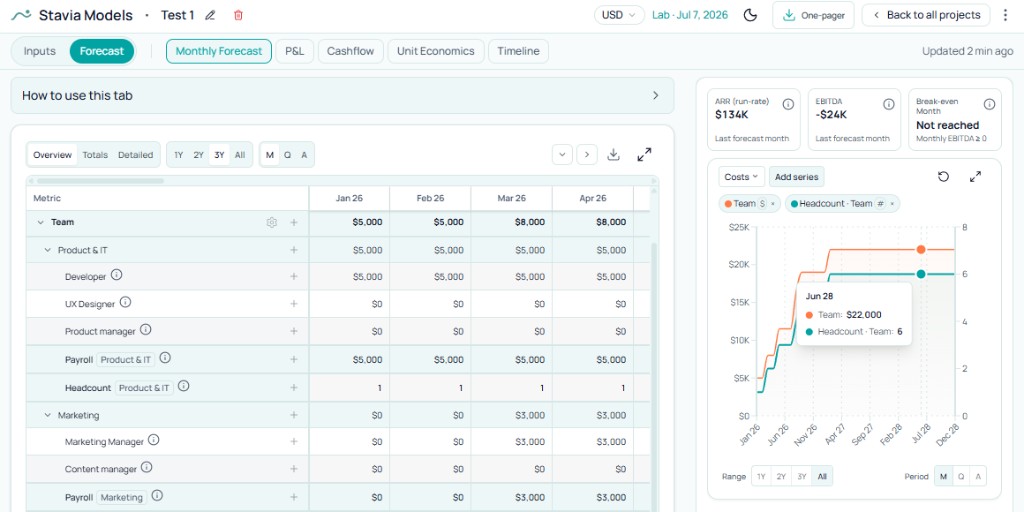
Payroll sits below gross profit. It does not directly change gross margin, even for technical or product roles. Gross profit remains revenue minus COGS. Payroll flows through operating expense, then into EBITDA, cash flow, runway, and funding need.
This matters because each hire changes more than salary totals. It changes monthly cash requirements and can materially shift how long existing capital lasts. A staged hiring plan makes those inflection points visible before they become financing problems.
How payroll maps into P&L categories
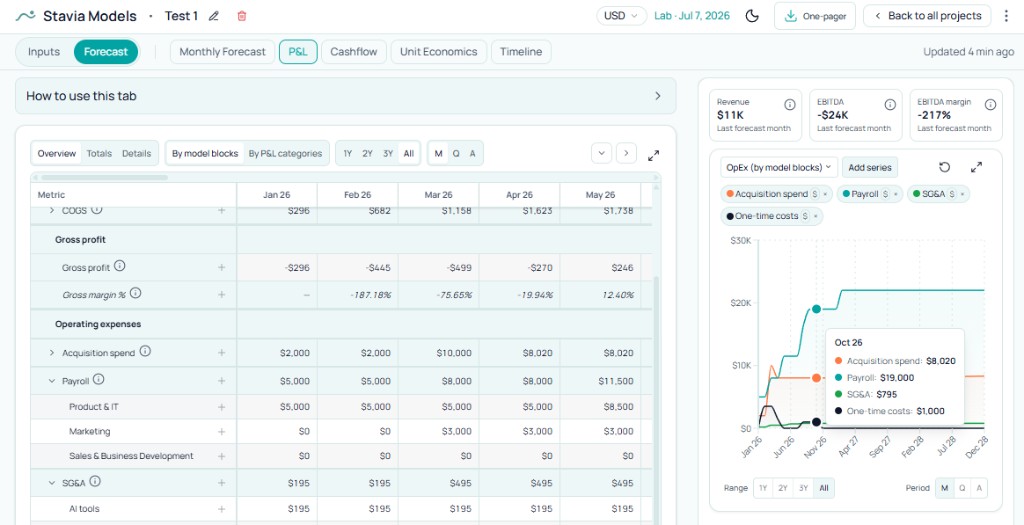
Founders usually think in departments first: Product & IT, Marketing, Sales, Administrative. P&L readers usually think in functional categories: R&D, Sales & Marketing, and G&A. Both views are useful, and they solve different problems.
In planning, departments represent the org you are building. In summary and investor communication, P&L categories show where the company is investing: building, selling, or running the business. Product & IT may map to R&D, Marketing may map to S&M, and Administrative may map to G&A.
This is why the question is larger than total salary. Founders need to see functional investment shape over time, not just total payroll growth. The same hiring budget can produce very different company trajectories depending on where it is allocated.
Public company filings are useful for understanding this category structure, not for copying hiring ratios. Mature SaaS businesses usually present operating expenses through R&D, Sales & Marketing, and G&A, and compensation is often a major component inside those functions. For an early-stage founder, the useful lesson is functional mapping: show where team spend is going — building, selling, or running the company. Light references: Atlassian investor relations and HubSpot investor relations.
How to organize this in Stavia
- Start with departments that reflect how you think about the company.
- Add roles one by one with monthly salary, hire month, and optional end month.
- Use later hire months to model staged hiring by milestone.
- Set P&L categories so payroll rolls into R&D, S&M, or G&A for reporting.
- Keep AI tools, agencies, professional services, and one-time work outside Team unless you intentionally want to model them as recurring contractor-style roles.
- Read the result through Monthly Forecast, P&L, and runway/funding logic.
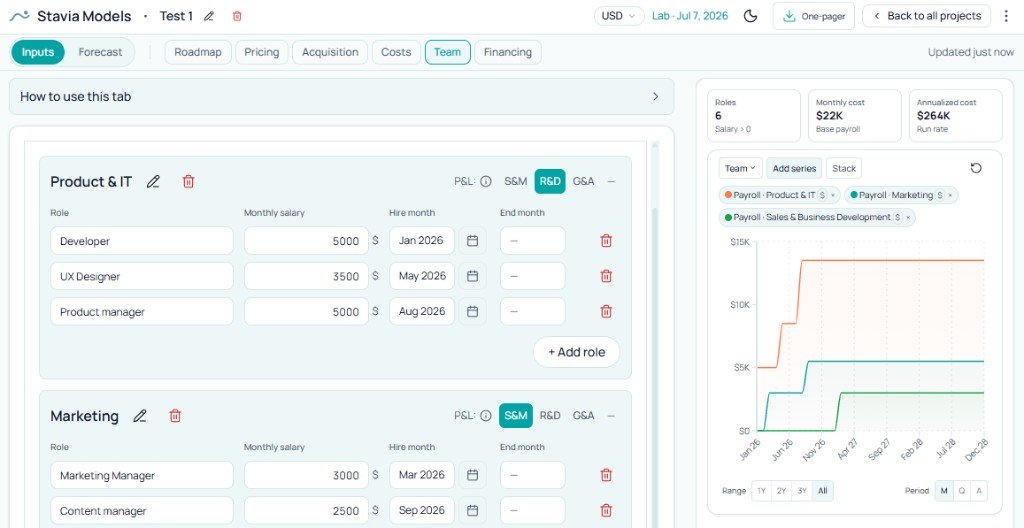
Next, assign each department a P&L category so roles inherit functional rollups automatically. Then read the model through Monthly Forecast for role and headcount timing, P&L for operating expense shape, and financing views for runway pressure as hiring scales. When you translate a raise into spending blocks, payroll is usually the clearest committed line — see startup use of funds planning for how hiring timing connects to allocation, evidence, and monthly burn.
Payroll planning works best when it is modeled beside pricing and growth assumptions. If you are stress-testing hiring speed, it helps to keep pricing assumptions realistic in parallel; this is where pricing structure and paid-acquisition pacing should be read together with payroll.
Common mistakes
Conclusion
A headcount plan is one of the clearest tests of founder discipline. It shows whether payroll is tied to the next milestone or to a future org chart that has not been earned yet.
AI tools and contractors can keep the first stage leaner. Full-time ownership becomes more important as the product matures and reliability expectations rise. A good model makes that progression explicit, so burn and funding plans stay credible. Payroll timing is one layer in a connected startup financial model where hiring, costs, and runway share one forecast.
About the author

Anastasiia Nikolaeva
Founder of Stavia Models
Anastasiia Nikolaeva is a financial modeling consultant and the founder of Stavia Models. She has built financial models for SaaS, AI, marketplace, and other startup business models, helping founders plan pricing, growth, fundraising, and unit economics. Stavia Models is based on this hands-on consulting experience and turns that modeling logic into a guided product.