
How Many Partner Signups Can You Really Put in Your SaaS Forecast?
Partners can carry early distribution — but one vague line in the spreadsheet is how forecasts drift. Here is how to model partner and affiliate acquisition from signups, conversion, and payout without overbuilding.
Model one partner channel
Adjust signups, conversion, and payout to see the 12-month effect.
12-month totals
Early on, the site is thin, organic is still warming up, and paid spend hurts before the funnel is proven. So founders look for someone who already has the audience: an incubator, an agency, a consultant, later maybe affiliates. That path is real, and it can sit in the forecast.
It is also easy to overstate. One optimistic "partners" line, with no sense of partner type, duration, audience warmth, or what you pay per customer, is how models quietly detach from how you actually sell.
The workable version is smaller: a few named partner shapes, conservative monthly signups, clear conversion and payout, and end dates when the relationship is time-boxed. Enough to stress-test the story without building a second CRM inside the sheet.
For where this sits next to paid, organic, and referral, see How to Model Acquisition Channels for Self-Serve SaaS.
Why partners matter so early
You are not inventing demand from zero. The right partner already talks to your buyers. An accelerator surfaces you to founders in the batch. An agency lives inside client workflows. A consultant bundles you into implementation. Distribution is borrowed, which makes the first months feel more reachable on paper.
None of that removes the work. Someone still has to earn trust, explain the product, align incentives, and get partners to actually send people. Signups show up after relationships and positioning, not the moment you add a row called "Partners."
The forecast should reflect that: include the channel, keep signup assumptions conservative, and split motions that behave differently so you are not defending one blended fiction.
Three partner channel shapes
"Partner" covers several realities. In the model they read cleaner as three recurring patterns.
Ecosystem partner
Distribution through a network or platform that already gathers your buyers — sometimes time-boxed, sometimes ongoing. Often warm traffic; shape and duration vary by program.
Agency / consultant
Lower volume, closer to the customer problem. Recommendations land in real work. Conversion can be high; payout often reflects real effort, not a link drop.
Affiliate program
Broader reach, more scalable, usually cooler traffic and lower per-signup intimacy. Often a better fit once positioning and conversion are proven.
Who already has your customer?
For many B2C, prosumer, or creator-adjacent products, affiliate-style motion often runs through creators, publishers, newsletters, communities, and influencers — people whose audience already opts into a topic or lifestyle.
For B2B, the same logic often points toward agencies, consultants, implementation partners, incubators, startup programs, integration partners, and broader industry or platform ecosystems — organizations that already sit in the buying process.
This is not a rigid rule. The useful question is always the same: who already has trusted access to the people you need to reach, and under what terms will they send them your way?
Start with signups, not traffic
For partners and affiliates, the early-stage unit is usually monthly signups — not visits, clicks, or "number of partner accounts." In Stavia, the Partners / Affiliates block starts from partner signups per month, then applies growth, a cap, conversion, and payout. That is the right level of detail for most seed-stage forecasts.
You could later unpack partners per cohort, signups per partner, activation rates, and separate curves by tier. Useful when the channel is material. Before that, extra granularity often adds noise.
The question worth answering first: once this source is active, how many signups per month is it reasonable to expect? Everything else hangs off that.
Ecosystem partners
An ecosystem partner is any organized context that already aggregates people you want as users: a shared calendar of events, a shared brand, or a shared platform where introductions happen with less cold outreach than raw performance marketing. You are borrowing reach and credibility from that environment.
Examples show up constantly in early-stage work: an incubator or accelerator, a founder community or cohort program, a VC's portfolio support layer, an industry association, a marketplace or platform that lists tools, or an integration ecosystem where partners recommend products that fit a stack. The common thread is density of the right buyers in one place.
Some of these relationships are naturally time-boxed — a batch ends, a grant period closes, a spotlight campaign runs for a quarter. Others can run for years: a standing partnership with a platform, a recurring channel inside an association, or ongoing co-marketing with an integration partner. Neither pattern is universal; the model should match the actual commitment on both sides.
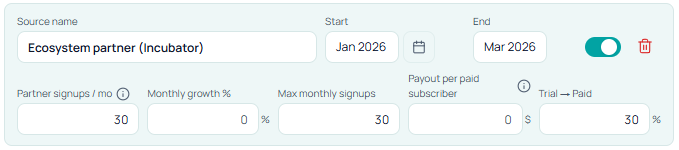
For many pre-seed and seed teams, the first concrete story is still a program window: you join an incubator or accelerator, or you are visible inside a startup program for a bounded period. Signups cluster there, then taper. In that situation, setting an end month in the forecast alongside believable monthly signups is often the right call. You are not required to model every ecosystem source that way — only the ones that really stop when the program stops.
Audiences from these sources are often warm, so trial-to-paid can look strong next to cold traffic. Payout may be zero when the trade is visibility and membership, not a per-customer fee. Keep ecosystem rows separate from a long-running affiliate program: same word "partner," different economics and duration.
Agencies: fewer signups, heavier context
Agencies and consultants are strong partners when they already sit next to the customer workflow — inside implementation projects, retainer relationships, or recurring advisory work. Their client trusts them on operational choices; that trust transfers when they recommend a tool. You are not buying anonymous clicks; you are buying a qualified introduction with context.
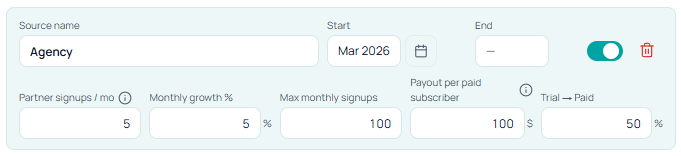
The help often goes beyond a single intro: scoping, onboarding, and how the product fits the client's stack and process. That environment supports higher trial-to-paid conversion than a generic link, which is why the model usually shows modest monthly signups paired with a stronger conversion column than a wide affiliate pool.
A higher payout per paid subscriber can still be rational here: the partner is carrying part of adoption and credibility, not just a tracking pixel. If conversion and retention hold, unit economics can beat a cheaper channel that never closes.
Volume alone is the wrong scorecard for this shape. Fit, trust transfer, and what happens after signup matter more.
Affiliate programs: usually a later layer
Affiliate motions are easy to sketch and harder to make work. They tend to reward clear positioning, a tight landing path, and proof that the offer converts. I usually treat them as a scalable layer on top of warmer motions, not the main character in month one.
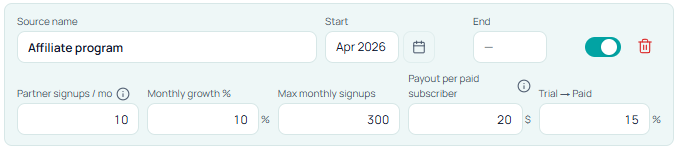
Compared with agencies or ecosystem pushes, affiliates often allow more signup headroom, smoother growth, lower payout per paid user, and cooler traffic with more average conversion. That is a different profile — useful, but not interchangeable with a consultant who already lives in the account.
If the product story is still moving or onboarding is rough, the forecast should not imply a strong affiliate engine. Match operating readiness, not the slide deck.
One growth input is enough for now
Real partner programs grow because more partners activate, because existing partners send more signups, or both. Stavia uses a single monthly growth rate on the signup stream — it does not split partner count from productivity.
For an early model, that is usually enough. One modest growth assumption can stand in for "more partners" and "better performance" together until you are running the channel with enough data to separate them.
Payout and unit economics
Partner payout is part of customer acquisition cost. In Stavia it is modeled as a fixed dollar amount per paid subscriber: in trial mode, on new paid subscribers from that partner source; in freemium mode, tied to free signups from the source and your product-level free-to-paid path. Those dollars flow into acquisition spend, the P&L, and blended CAC the same way paid media spend does.
That makes partner CAC directly comparable to paid acquisition CAC and to other channels in the same forecast. A row that looks attractive on signups alone can look weak once payout is divided through to paid customers. Another row can show a higher bounty per subscriber and still be the better deal if conversion or retention is strong enough to justify it.
In live partner deals, reward structures vary: fixed bounties or CPA, payout on first sale only, revenue share, hybrids, and caps. For early-stage planning, collapsing that into one effective dollar cost per paid subscriber is usually the simplest honest input — and it matches how Stavia keeps the block usable without turning the model into a contracts database.
How paid subscribers emerge from signups still depends on your access model — pricing and conversion after someone becomes paying sit downstream of the partner row.
Same signups, different economics
Agency
- 10 signups
- 50% trial → paid
- $100 payout per paid subscriber
→ 5 paid subscribers, $500 payout
Affiliate program
- 10 signups
- 15% trial → paid
- $20 payout per paid subscriber
→ 2 paid subscribers, $40 payout
Identical signup counts can produce very different paid users and very different CAC once payout is in the picture.
How signups become paid users over time also depends on trial vs freemium — same partner row, different calendar for revenue.
How this works in Stavia
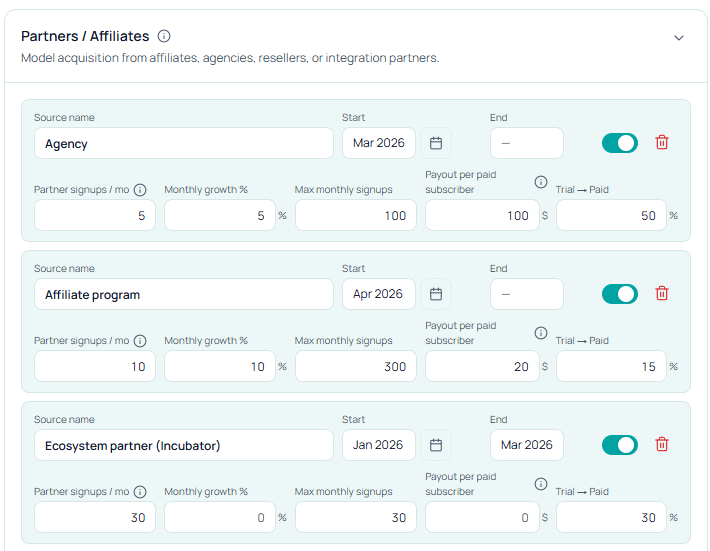
Partners / Affiliates is signup-based, not traffic-based. Each source has a start month, optional end month, partner signups per month, monthly growth on signups, max monthly signups, payout per paid subscriber, and trial-to-paid in trial mode. The first active month uses your base signup count; later months compound from the prior month until they hit the cap. When an end month is set, it is the last active month for that source. Multiple sources sum into partner totals in the forecast.
In trial mode, partner signups count as trials in the same month; new paid subscribers follow your trial-to-paid rate for that source. In freemium mode, partner signups feed free signups first, and paid conversion follows your product-level freemium settings — Free Trial vs Freemium covers that path.
One growth percentage on signups stands in for both recruiting more active partners and getting more from partners who are already live. That is intentional for early models; you can split those drivers later if the channel becomes a planning priority.
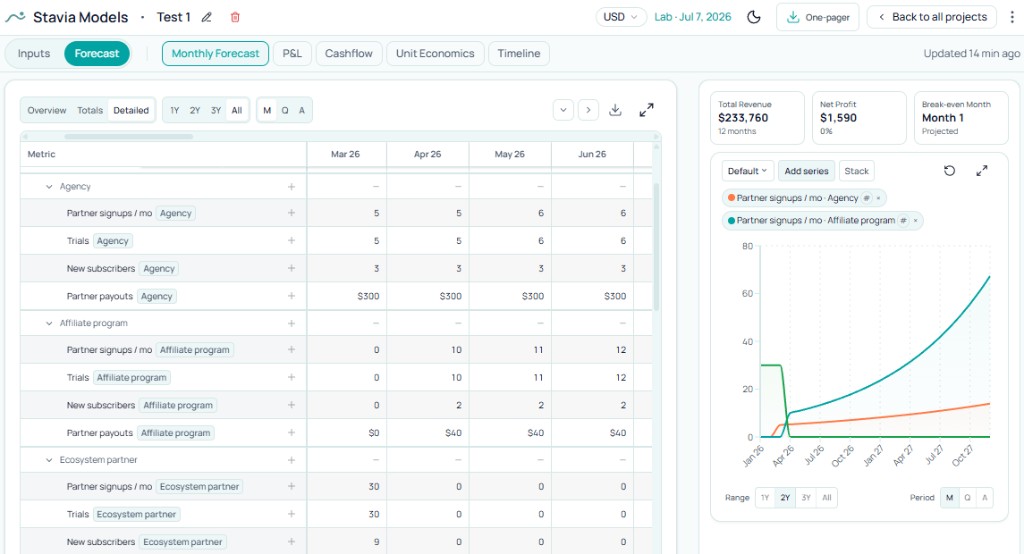
In Inputs, under Acquisition, add a Partners / Affiliates row for each motion you want in the plan — ecosystem window, agency, affiliate program, and so on. Set start and optional end month, partner signups per month, growth %, max monthly signups, payout per paid subscriber, and trial-to-paid where you are in trial mode. Then open Monthly Forecast, expand acquisition, and read signups, trials, new subscribers, and partner payouts by source next to paid, organic, and referral in the full channel picture.
For a first pass, name two or three partner types you can actually see in the next twelve months. For each, ask how many signups per month once the source is live, how warm the audience is, how long the relationship lasts, what payout matches the real deal, and whether the motion is active now or still hypothetical. You do not need a partner CRM in the spreadsheet — you need inputs you are willing to change when data arrives.
Common founder mistakes when modeling partner and affiliate acquisition
Conclusion
Partner channels can shorten the path to early traction when someone credible already reaches your buyer. They only help the forecast when you treat them like a real operating motion: split the channel into sources that behave differently, keep signups conservative, model payout as acquisition cost, and compare the resulting partner CAC to paid and everything else you rely on. Partner signups are one channel in a startup financial modeling guide that connects acquisition to pricing, costs, and runway.
The point of the exercise is a founder decision — whether this route is actually attractive once economics are visible, not whether the slide looks busy. Stavia Models keeps that check lightweight: separate partner rows, shared totals, and a straight line from signups into trials or free users, paid subscribers, payouts, and blended CAC.
About the author

Anastasiia Nikolaeva
Founder of Stavia Models
Anastasiia Nikolaeva is a financial modeling consultant and the founder of Stavia Models. She has built financial models for SaaS, AI, marketplace, and other startup business models, helping founders plan pricing, growth, fundraising, and unit economics. Stavia Models is based on this hands-on consulting experience and turns that modeling logic into a guided product.