
How to Model Acquisition Channels for a Self-Serve SaaS or AI Subscription Product
Acquisition is not one number. Paid, organic, partners, and referrals behave differently. Here is how to model them separately and see how they flow into trials, subscribers, CAC, and revenue.
Compare a channel mix
See how paid, organic, and referral channels change subscriber growth and blended CAC.
Paid scales fastest, organic compounds, and referral strengthens as the subscriber base grows.
For early-stage founders, customer acquisition is often where the financial model starts to lose realism. A lot of startup models still use one top-line growth rate, one blended CAC, or one vague assumption like "traffic will grow 15% per month." That may be enough for a rough sketch, but it breaks quickly once you try to understand what is actually driving growth.
This is especially true for self-serve subscription products. If users discover your product through ads, SEO, content, affiliates, or referrals, then start a trial or free plan and convert to paid without speaking to sales, acquisition is not one line in the model. It is a system of channels feeding a product-led funnel. Each acquisition source should be modeled separately.
In this guide, I'll show how to think about acquisition channels in a financial model for a self-serve SaaS or AI product, and how Stavia Models structures that logic across paid, organic, partner, and referral channels.
Why self-serve subscription products need channel-level acquisition modeling
In a sales-led business, acquisition often starts with leads, pipeline, and conversion by rep capacity. But in a self-serve subscription product, users move through the funnel on their own. They might click an ad and start a trial, find the product through search or content, come from an affiliate or partner, sign up through a referral loop, or enter a freemium plan and convert later.
Those paths look similar from far away. They all create customers. But from a modeling perspective, they are very different. Some channels start with traffic; others with signups. Some have cash spend; others have payouts only after conversion. Some depend on the existing user base. Some scale fast but get expensive; others compound slowly and improve blended CAC over time.
If all of that is collapsed into one growth line, the model becomes much less useful for strategy. You can no longer answer basic questions: Which channel is actually driving subscriber growth? Where is CAC coming from? How much growth depends on paid spend? What happens if SEO grows slower than expected? When do partner channels become meaningful? Is referral real, or just optimism in spreadsheet form?
For a self-serve product, acquisition should be modeled by channel because the funnel is product-driven, not sales-driven.
The four acquisition channel groups that belong in a subscription model
A practical way to structure self-serve acquisition is to split it into four groups: paid performance, organic / owned, partners / affiliates, and referral / virality. Each group behaves differently in both the input layer and the forecast. Paid and organic start with traffic (clicks or visits) and convert into trials or free signups. Partners and referral are signup-based: they generate signups directly, without the same traffic layer. That distinction matters for the model: paid needs spend and buying assumptions; organic needs growth and a traffic cap; partners need payout economics; referral depends on the active user base.
How to model acquisition channels in a financial model
In a financial model, acquisition should be built as a channel system rather than one blended assumption. The logic is straightforward: each channel produces volume (clicks, visits, or signups), that volume converts through the funnel, and the outputs feed into acquisition spend, new subscribers, and CAC. The model needs to separate those paths so you can see which channel drives growth, which drives cost, and how changes in one affect the whole.
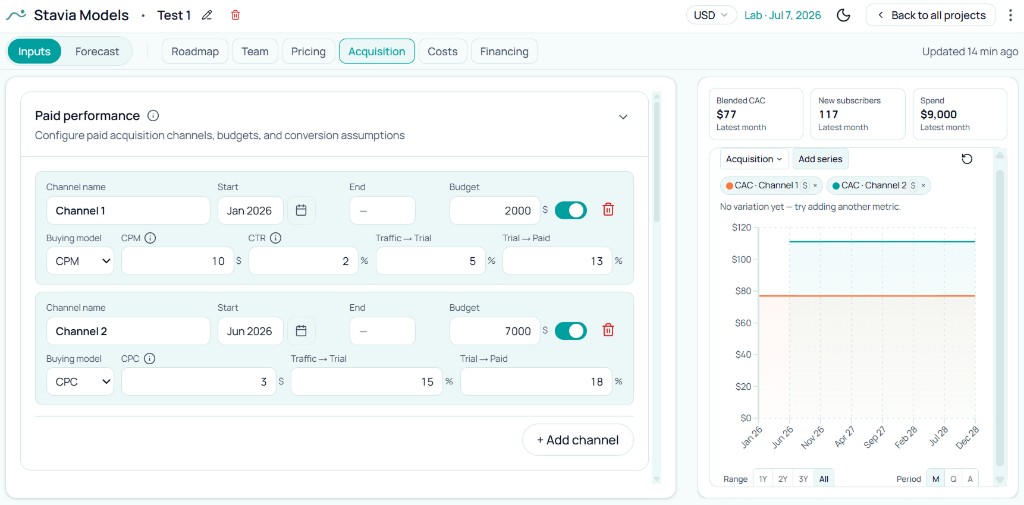
Paid performance starts from budget and buying assumptions (CPC or CPM/CTR), then flows into clicks, trials or free signups, and paid conversions. Paid acquisition planning shows how to test spend, buying logic, and conversion before you scale. Organic / owned starts from monthly visits, growth, and a cap — broader than SEO alone, including content, direct traffic, newsletter, and other owned distribution. An organic acquisition forecast breaks non-paid traffic into sources you can defend. Partners / affiliates starts from monthly signups plus payout per paid subscriber. A partner acquisition forecast covers signups, caps, payouts, and end dates. Referral / virality starts from the user base itself; volume depends on how many eligible users already exist. In Stavia Models, this logic is implemented as a channel system so founders can model each source separately and see the results in the forecast.
Paid performance
Paid performance is the most direct acquisition engine: budget → clicks → trial or free signup → paid. Each paid channel needs monthly budget, buying model (CPC or CPM), and conversion assumptions. In a CPC channel, spend divided by cost per click gives you clicks. In a CPM channel, spend gives impressions, and impressions × CTR give clicks. Those clicks move into the self-serve funnel and convert. The financial output is clear: acquisition spend goes up with budget, and CAC depends on how efficiently clicks convert to paid subscribers.
That is why separating paid channels matters. One channel may look cheaper on CPC but worse on click-to-trial conversion. Another may have a higher CPC but stronger trial-to-paid behavior. A single blended CAC hides that. Channel-level modeling shows which paid source actually drives subscribers and what it costs.
Organic / owned
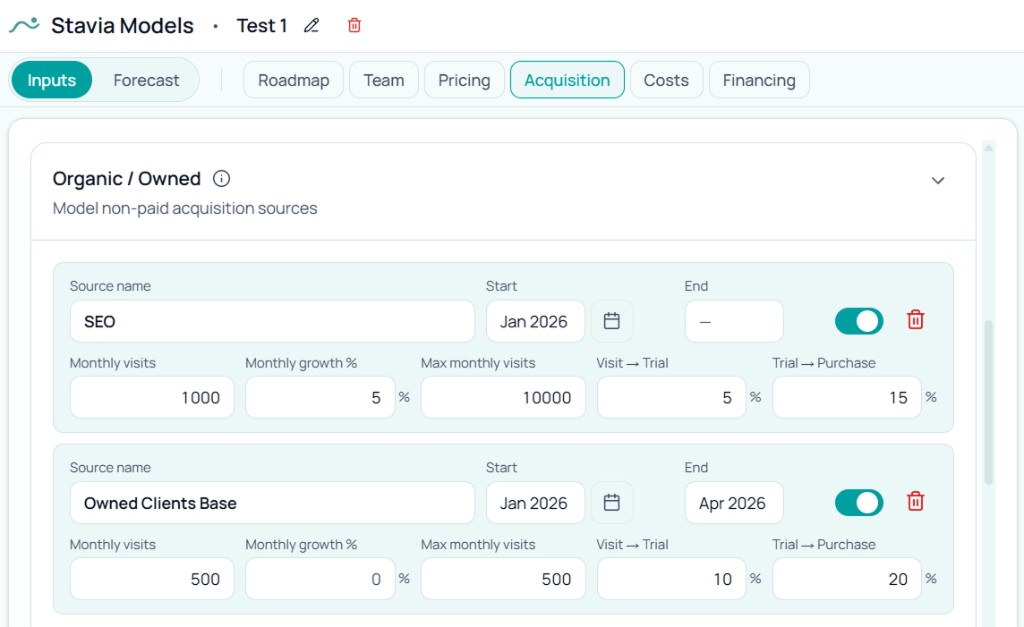
Organic / owned is modeled from visits, not spend. The core inputs are monthly visits, growth rate, max visits, and conversion into trial or free signup. Founders often think of it as SEO, but it is broader: content, direct traffic, newsletter, community, and other non-paid distribution you control.
The key financial logic is compounding growth with a cap. Organic channels grow month by month, but not forever — the cap prevents fantasy traffic curves. Compared with paid, organic has no direct acquisition spend and growth driven by traffic assumptions, not budget. That means organic often improves blended CAC over time: it adds subscriber volume without increasing spend the way paid channels do. Model it explicitly rather than treating it as "free growth."
Partners / affiliates
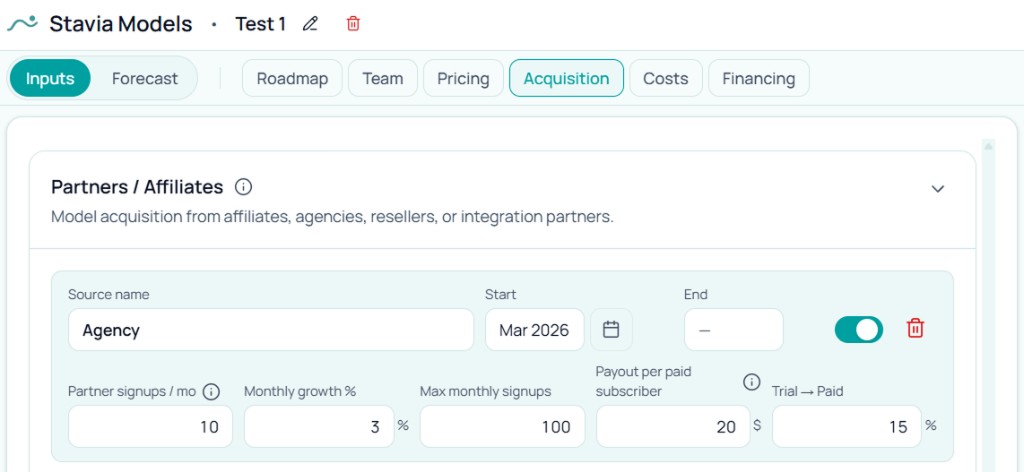
Partners and affiliates are signup-based: you start from signups delivered by the partner, not from clicks or visits. The main inputs are monthly signups, growth rate, signup cap, payout per paid subscriber, and conversion into paid. The volume side behaves like a growth curve with a cap.
The financial catch is payout economics. Payout is usually paid per paid subscriber, not per visitor. That payout belongs in acquisition spend. Founders often underestimate CAC here: a partner channel may look attractive because it drives signups without internal ad management, but if the payout is meaningful, it still increases acquisition cost and affects blended CAC.
Referral / virality
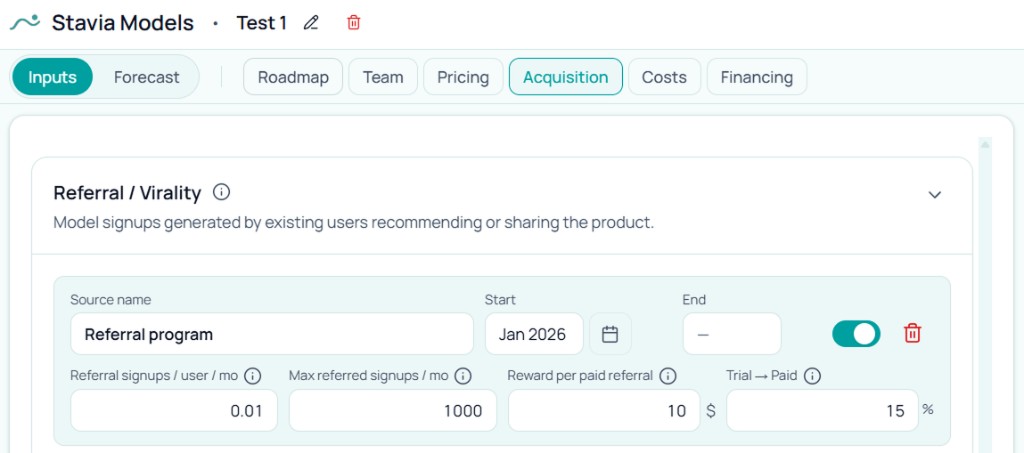
Referral / virality depends on the user base itself. The logic is not traffic in, signup out. It is: existing users create additional signups. The core inputs are referred signups per active user, max monthly referred signups, reward per paid referral, and conversion into paid.
That makes referral behave very differently from the other channels. It should not be modeled as a flat percentage of signups or a static extra line. If the active base grows, referral potential grows; if retention is weak, the loop weakens. The financial model needs to reflect that dependency. Reward costs flow into acquisition spend, so referral can improve or worsen blended CAC depending on how the loop performs.
Trial vs freemium
The access model (trial vs freemium) affects timing — trial converts faster, freemium delays conversion through the free base — but the channel structure is the same. For trial vs freemium trade-offs, modeling both helps.
How these channels appear in the forecast
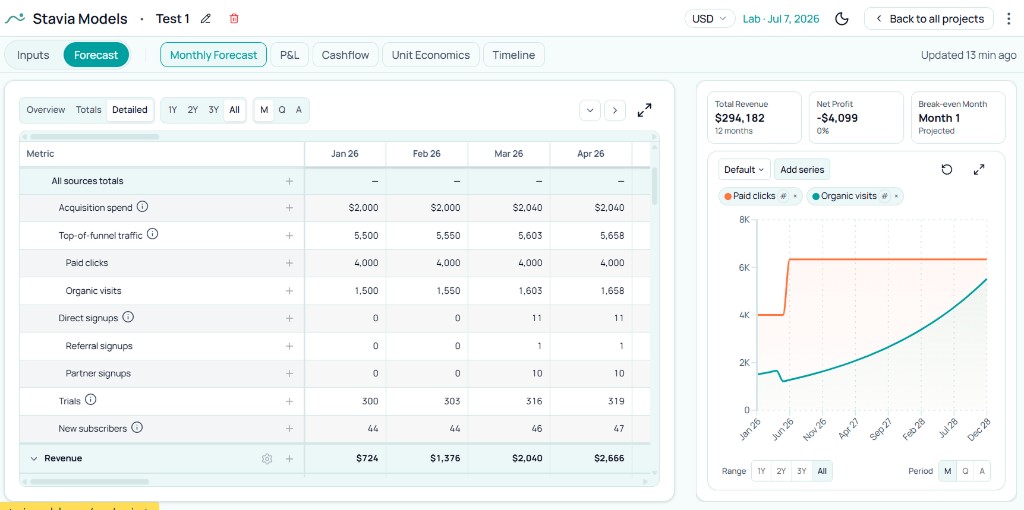
Once acquisition assumptions are modeled separately, they become much easier to track in the forecast. In the monthly forecast, you can see acquisition spend, top-of-funnel traffic, paid clicks, organic visits, direct signups, trials, and new subscribers. That gives you a clean bridge from inputs to outputs.
Instead of asking whether your revenue forecast feels too optimistic, you can ask more specific questions. Is spend high enough to justify paid click volume? Is organic growth doing too much work in the model? Are partner signups realistic? Is referral contributing before the active user base is large enough? Is trial conversion carrying too much of the outcome?
Once paid subscribers exist, how you split them across plans and billing still shapes ARPA, cash receipts, and LTV in the rest of the forecast.
When the product reaches users in weeks instead of months, channel tests and conversion assumptions move into the first operating quarter. See how to build a startup financial model when AI lets you launch faster for how compressed launch timing changes early acquisition pacing and runway pressure.
That is where acquisition modeling becomes strategic. It stops being a set of abstract assumptions and becomes a decision tool.
Common founder mistakes when modeling acquisition
What decisions founders can make with this structure
Once acquisition is modeled this way, the forecast becomes useful for real decisions. You can compare paid channels and understand what is really driving CAC. You can test whether organic growth is strong enough to reduce blended CAC over time. You can see whether partner economics are actually attractive after payouts, and whether a referral program is meaningful or still too early to matter. You can compare trial and freemium as funnel structures, not just as pricing concepts, and phase channels over time instead of assuming every growth engine starts on day one.
That is the real value of channel-level acquisition modeling. It makes the model useful before launch, before fundraising, and before the company has much historical data — and it connects all of that to unit economics: blended CAC, LTV:CAC, and payback. For AI subscription products, compare channel CAC to contribution only after usage COGS is modeled — see action-based AI product cost forecasting before scaling spend on channels that fill trial or free tiers.
How to use Stavia Models for acquisition
The easiest way to pressure-test acquisition assumptions is to model each channel separately.
- In the Acquisition inputs, add paid channels with budget, CPC or CPM, and conversion rates.
- Add organic sources with monthly visits, growth, and cap.
- Add partner sources with signup volume and payout per paid.
- Add referral sources with referral rate and reward per referred paid.
- Go to the Monthly Forecast and expand the Acquisition section to see spend, traffic, and subscribers by channel.
The goal is not to predict the future perfectly. It is to structure your assumptions so you can see how each channel affects growth and cost before you scale.
Conclusion
For a self-serve SaaS or AI subscription product, acquisition is not one number. It is a system of channels feeding a product-led funnel. Paid performance, organic, partners, and referral all create growth in different ways. They use different assumptions, create different cost structures, and affect CAC and subscriber growth differently.
If you model them separately, the forecast becomes much more realistic and much more useful. That is the logic behind how Stavia Models handles acquisition. Instead of hiding growth behind one line, it lets founders model how each channel actually behaves — and how those channels flow into trials, signups, paid subscribers, CAC, and revenue over time.
If your product grows through self-serve trial or freemium, that level of detail is not over-modeling. It is what makes the strategy visible. Those channels also sit inside a financial model for startup decisions where pricing, costs, runway, and unit economics share one forecast.
About the author

Anastasiia Nikolaeva
Founder of Stavia Models
Anastasiia Nikolaeva is a financial modeling consultant and the founder of Stavia Models. She has built financial models for SaaS, AI, marketplace, and other startup business models, helping founders plan pricing, growth, fundraising, and unit economics. Stavia Models is based on this hands-on consulting experience and turns that modeling logic into a guided product.