
Financial Projections for Pre-Seed and Seed in the AI Era: From Prototype to Proof
AI tools make it easier to build early prototypes, but investors still need proof that the product can become a business. This article explains how to connect funding, runway, milestones, revenue logic, and cost-to-serve in pre-seed and seed projections.
Many founders still prepare financial projections for fundraising as if investors are asking them to predict the future. At pre-seed and seed, that has never been completely true. Early-stage investors know that the numbers will change.
What has changed is the amount of evidence founders may be expected to bring before the first serious check.
In the AI era, many early tasks are cheaper and faster than before. Founders can research a market, build a landing page, create a demo, test messaging, prototype an interface, generate content, automate parts of customer discovery, and sometimes build a functional MVP before raising capital. For software, SaaS, subscription, and AI-native products, the old idea that pre-seed money simply funds the first version of the product is becoming less reliable.
This does not mean every startup should be bootstrapped to a product. Deep tech, hardware, regulated products, infrastructure-heavy tools, and some enterprise products still need capital before the first usable version is possible. But in many digital businesses, investors are now more likely to ask what the founder has already tested with limited resources.
That changes the role of the financial model. Pre-seed and seed projections should not only show how much money the company wants to raise. They should show how early evidence becomes stronger proof: product usage, pilots, paid conversion, revenue logic, cost-to-serve clarity, runway discipline, and a more fundable next milestone.
Venture capital is still available, but it is more selective and more concentrated. CB Insights reported that global venture funding grew in 2025 while deal count fell, with large rounds taking a major share of total funding. Carta's 2025 pre-seed data shows a similar concentration pattern at the earliest stages: U.S. startups on Carta raised almost the same amount of pre-seed cash as in 2024, but across fewer SAFEs and convertible notes.
For founders, the practical lesson is simple. A useful financial model should not make the startup look stronger by drawing a more aggressive revenue curve. It should make the plan easier to understand: what has already been tested, what still needs to be proven, what the next round of capital will fund, and whether the economics can support the business behind the product.
From prototype to proof
Prototype or early evidence
What you may already have
Demo, MVP, pilot conversations, waitlist, usage, LOIs, or first paid tests.
Funding check
What the round adds
Capital needed to move from early signal to stronger proof.
Budget and burn
Where it goes
Product, team, GTM, tools, AI/API costs, operations, and buffer.
Milestones
What it should create
Usage, paid conversion, pilots, retention, revenue learning, or margin clarity.
Next fundable proof
Why it matters
Evidence that supports seed, Series A, or a stronger commercial plan.
Why pre-seed expectations changed
Pre-seed used to be easier to describe as money for the first build. A founder had an idea, a deck, a market thesis, and a plan to use capital to create the first version of the product.
That framing still exists in some sectors, but it is less universal now. AI tools, no-code tools, low-code tools, coding assistants, design tools, research tools, and cheaper cloud infrastructure have changed what can be done before fundraising. A small team can often arrive at the first investor conversation with more than a concept. As a16z noted in early 2026, code has become cheaper — and the harder problem is increasingly what to build and how to turn it into a real business.
That does not automatically make the startup stronger. It changes what investors can reasonably ask. If a founder can build a demo quickly, the demo alone becomes a weaker signal. The stronger signal is what the demo helped the founder learn: whether users tried it, a design partner agreed to test it, a customer described a real workflow problem, someone asked for pricing, early usage revealed cost-to-serve risks, or the first customer segment turned out to be wrong.
This is where financial projections become useful. The model should show what the founder will do with the next amount of capital after the easiest early work has already been done, and whether the round funds real progress or only postpones validation. Fusion VC's 2025 pre-seed analysis captures this tension well: AI may make it much easier to build, but easier building does not equal paying customers. Carta's Q2 2025 pre-seed data also suggests the earliest-stage market continues to evolve as AI productivity changes what founders can show before raising.
Pre-seed and seed projections answer different questions now
The classic distinction between pre-seed and seed is still useful, but it needs an AI-era update. The difference is no longer only product stage or forecast length. The more important question is the level of proof.
Pre-seed
Classic expectation
Idea, deck, early team, and budget to build the first version.
AI-era expectation
Prototype, demo, MVP, customer discovery, design partners, pilot conversations, waitlist, usage, or first commercial signal where possible.
Model should show
How the first real check turns early evidence into stronger proof: product work, founder runway, first hires or contractors, GTM tests, validation, burn, runway, and milestone coverage.
Seed
Classic expectation
Product launched, early traction, and plan to grow.
AI-era expectation
Stronger evidence that the product can become a business: paid conversion, sales motion, retention, usage quality, cost-to-serve, gross margin, CAC direction, and path to the next fundable stage.
Model should show
A structured 24–36 month forecast connecting revenue model, acquisition channels, conversion, cost of revenue, payroll, cash flow, runway, unit economics, and funding need.
At pre-seed, investors may still accept uncertainty, but they are less patient with avoidable vagueness. If a founder says the round will fund "product and growth," the model should show what product work, which growth tests, what budget, what timing, and what evidence those activities should create.
At seed, the bar moves from possibility to repeatability. A seed model should usually explain how early validation becomes a more predictable commercial engine. That does not mean the company has solved everything. It means the founder can connect the evidence already collected with the next operating plan.
The first check should not fund the first thinking
A useful way to frame pre-seed today is that the first check should fund the next proof, not the first round of thinking. Before raising, founders should ideally understand the problem, the first customer segment, the basic market logic, the likely pricing direction, the first go-to-market path, and the first version of the product. They do not need perfect answers, but they should be able to show that the business has been thought through beyond the pitch deck.
The model should make this visible. If the founder has already built a prototype, the financial plan should show what happens next: product hardening, onboarding, design partners, the first sales motion, usage testing, paid conversion, or technical reliability. If the founder has customer conversations but no product, the model should show how those conversations become pilots or paid tests. If the founder has a waitlist, the model should show how waitlist users convert, activate, retain, and eventually pay.
This is also where the financial model protects the founder from confusing activity with progress. A startup can spend money on product, content, tools, events, contractors, and ads without becoming more fundable. The model should force the question: what evidence will this spending create?
Prototype is not proof
A prototype is useful because it makes the idea concrete. It can help founders test workflows, gather feedback, show the product to customers, and start investor conversations. But in the AI era, prototypes are easier to create, which means investors may discount them faster unless they are connected to customer evidence.
For B2B SaaS, useful proof may be a design partner, a pilot, a paid pilot, a strong pipeline of qualified conversations, or evidence that the buyer owns the problem and has budget. For a self-serve subscription product, useful proof may be activation, conversion, retention, repeat usage, or willingness to pay. For an AI product, useful proof may include not only user interest, but also cost-to-serve, gross margin, and whether heavy users can be served profitably.
The financial model should separate these types of evidence. A waitlist is not the same as activated users. Activated users are not the same as paid users. Paid users are not the same as profitable users. A pilot is not the same as a repeatable sales motion. Investor projections become more credible when the model shows these transitions clearly.
What milestones should your model connect to the round?
The right milestone depends on the type of product, business model, and stage. A technical product, a B2B SaaS company, a self-serve subscription product, and an AI-native product should not all use the same fundraising model. The budget, timeline, and proof points should match the kind of evidence the startup needs to create.
Milestones by startup type
Budget, timeline, and proof points should match the kind of evidence each model needs to create.
AI or software product
Before the round
Research, prototype, demo, landing page, early users, discovery, waitlist, or first usage.
Round should prove
Reliability, paid conversion, retention, cost-to-serve, usage limits, and clearer commercial model.
Model implication
Product team, AI/API costs, hosting, support, GTM tests, pricing, free usage limits, and runway buffer.
B2B SaaS
Before the round
Customer discovery, founder-led outreach, clickable demo, pipeline, LOIs, or design partners.
Round should prove
Pilot-to-paid conversion, buyer urgency, sales cycle, onboarding effort, and early repeatable sales motion.
Model implication
Sales capacity, pilot revenue, sales timing, onboarding costs, support, payroll timing, and cash runway.
Self-serve subscription
Before the round
Landing page, content tests, waitlist, onboarding flow, early usage, or small paid acquisition tests.
Round should prove
Activation, paid conversion, retention, CAC range, churn, and plan economics.
Model implication
Channel assumptions, trial or freemium costs, paid conversion, churn, CAC, ARPA, and unit economics.
Marketplace
Before the round
Segment research, supply or demand interviews, manual matching, and early liquidity tests.
Round should prove
Whether supply and demand can be built together in one focused segment.
Model implication
Two-sided acquisition costs, manual operations, transaction assumptions, liquidity timing, and narrow launch scope.
Deep tech, hardware, or regulated product
Before the round
Research, technical plan, prototype where possible, partner conversations, or grant/incubator support.
Round should prove
Technical feasibility, certification path, production plan, regulatory progress, or first partner validation.
Model implication
R&D budget, equipment, contractors, longer runway, staged technical milestones, and milestone-based spending.
These examples are not templates to copy directly. They show the level of specificity that makes a fundraising model useful. For a B2B SaaS product, a model that only shows website traffic and self-serve conversion may miss the actual sales process. For an AI subscription product, a model that ignores free usage and API costs may hide the real margin risk. For a marketplace, a simple customer growth curve may be weak if it does not explain how supply and demand will be created together.
How market size should connect to the revenue model
Pitch decks often include a market size slide. That slide can be useful, but it does not explain how the startup will actually capture value. Market size shows the opportunity; the revenue model shows how the company makes money; the financial model should connect both.
Two paths to $1M ARR
The same revenue target creates very different operating questions depending on pricing and go-to-market.
$50/month self-serve subscription
About 1,667 paying subscribers
Investor questions
- Where will that many users come from?
- What conversion rate is assumed?
- What churn is realistic?
- What CAC can the business afford?
$20k/year B2B SaaS product
50 paying customers
Investor questions
- How long is the sales cycle?
- How many qualified leads are needed?
- Who sells?
- What onboarding or support is required?
The self-serve subscription path depends on traffic, activation, paid conversion, churn, support load, and acquisition efficiency. The B2B SaaS path depends on pipeline, sales capacity, pilot-to-paid conversion, contract timing, onboarding effort, and customer concentration. Top-down market sizing is not enough for investor projections. A founder can show that the market is large, but the model still needs to show what pricing, customer count, acquisition, conversion, churn, and cost assumptions would make the revenue path possible. Use the market slide to show ambition. Use the financial model to show operating logic.
For the full framework, see the startup financial modeling guide and the article on top-down vs bottom-up startup forecasting.
AI makes cost-to-serve visible earlier
One of the biggest differences in AI-era financial projections is the cost side. A SaaS product can often grow users before direct serving costs become painful. An AI product can feel margin pressure much earlier if usage is expensive, free users are active, or heavy users consume more than the pricing model supports.
This is why AI startup projections should show cost-to-serve earlier than a classic pre-seed model might have done. The model should not wait until later-stage planning to include API costs, inference costs, usage caps, free usage, trial limits, plan-level usage, and gross margin. Bessemer's State of AI 2025 makes this point from the other side of the market: some AI companies can grow revenue extremely quickly, but top-line ARR does not automatically mean a healthy business. Margins, retention, engagement, and capital efficiency still matter.
For an early-stage founder, the practical question is whether the company can afford the usage if users love the product. The model should help answer that before the startup spends heavily on acquisition or gives away too much free access. See the AI/API cost forecast and cost of revenue and gross margin articles for how to model this in detail.
What should be in the pitch deck and what should stay in the full model?
Founders often try to put too much of the model into the pitch deck. The financial slide in the deck should not become a spreadsheet screenshot. It should show the few numbers that support the fundraising story. The full model should sit behind the deck and help the founder answer follow-up questions.
The pitch deck usually connects several slides: market size, business model, go-to-market strategy, traction, financial projections, use of funds, milestones, and fundraising ask. These slides should not tell separate stories. They should be connected by the same financial logic. If the deck says the startup is targeting enterprise customers, the model should not assume instant self-serve conversion. If the deck says growth will come from paid acquisition, the model should show CAC, conversion, spend timing, and payback logic. If the deck says the product is AI-powered, the model should show AI/API usage costs and gross margin pressure.
Deck shows
High-level revenue trajectory
Full model explains
Pricing, plan mix, billing, conversion, churn, expansion, and customer count.
Deck shows
Burn and runway summary
Full model explains
Monthly cash flow, starting cash, operating outflows, hiring, acquisition spend, ending cash, and runway.
Deck shows
Use of funds
Full model explains
Product, team, GTM, operations, tools, AI/API costs, one-time costs, and buffer.
Deck shows
Milestones
Full model explains
Month-by-month logic showing when product, pilots, users, revenue, or hiring milestones happen.
Deck shows
Key KPIs
Full model explains
Unit economics, CAC, ARPA, gross margin, payback, LTV:CAC, and contribution logic.
The deck should make the plan understandable. The model should make it defensible.
The first 6–12 months should be especially clear
For early-stage investors, the first months often matter more than the long-range revenue curve. This is where the model becomes operational. This is where the investor can see what happens immediately after the money arrives: when product work starts, which roles or contractors are needed, when acquisition begins, when pilots or customer conversations are expected, how long it takes before revenue appears, which costs are fixed from the beginning, which costs depend on usage or customer growth, and how much buffer the company has if milestones take longer.
A 36-month forecast may be useful, especially at seed. But if the first 6–12 months are vague, the model will feel weak. In the AI era, this is even more important because founders may already have a prototype before raising — see how AI-compressed launch timelines change the financial model for the first 30, 60, and 90 days after go-live. When the prototype already exists, the next layer is post-MVP validation — see how to model an AI MVP built in days for usage COGS, conversion, and stop/iterate decisions in that window. The first months after the round should show what changes because of the capital.
For a technical product, that may mean moving from prototype to reliable product. For a B2B product, it may mean converting customer conversations into pilots or paid pilots. For a self-serve product, it may mean testing activation, paid conversion, and retention. For an AI product, it may mean proving that users want the product and that usage does not destroy gross margin. Cash flow, hiring, product timing, GTM activity, and milestones should be visible together before the founder is already spending the money.
What the model should include
A pre-seed or seed model does not need to be complicated for the sake of looking sophisticated. It should connect the main business drivers well enough to explain how the company could move from early evidence to stronger proof, and from stronger proof to the next stage. The core sections are usually revenue, acquisition, costs, team, cash flow, runway, and unit economics.
Revenue model
For SaaS and subscription products, this usually means pricing plans, monthly or annual billing, plan mix, new customers or subscribers, free trial or freemium conversion, churn, and sometimes expansion or upgrades. The main question is whether the pricing and customer growth logic can support the revenue story. In the AI era, pricing also needs to connect to usage. If the product has expensive AI actions, the model should show whether the plan price can support the average user and what happens when usage is higher than expected. See SaaS pricing and revenue assumptions, the free trial vs freemium model, and action-based AI product cost forecasting when usage behavior drives COGS.
Acquisition and go-to-market logic
A revenue forecast without acquisition logic is usually not enough. Organic traffic, paid acquisition, partners, referrals, founder-led sales, and outbound sales have different timing, cost, conversion, capacity, and risk. A stronger acquisition model separates the channels instead of using one generic growth rate. The model should show how acquisition turns into leads, signups, pilots, paid customers, or subscribers, how much that growth costs, and when the company expects to learn whether a channel is worth continuing. See the acquisition channel model and paid acquisition and CAC assumptions.
Cost structure and gross margin
The model should separate cost of revenue from overhead. Hosting, payment processing, support tied to serving customers, AI/API usage, and other direct serving costs affect gross margin. Software tools, admin, general overhead, one-time setup costs, payroll, and sales and marketing spend affect burn and runway in a different way. For AI products, free users, trial users, heavy usage, API calls, inference costs, and plan limits can change the economics quickly. See the startup cost structure model, cost of revenue and gross margin, and AI/API cost forecast.
Payroll and hiring timing
Hiring is often the largest driver of burn. The model should show who needs to be hired, when each role starts, and why the timing makes sense. Product roles should connect to product development. Sales roles should connect to a sales motion that exists or is being tested. The AI-era nuance is that some work may be done with a smaller team than before, but AI tools can also create new costs: subscriptions, infrastructure, API usage, quality control, and technical debt. See the article on payroll and hiring timing.
Cash flow, burn, and runway
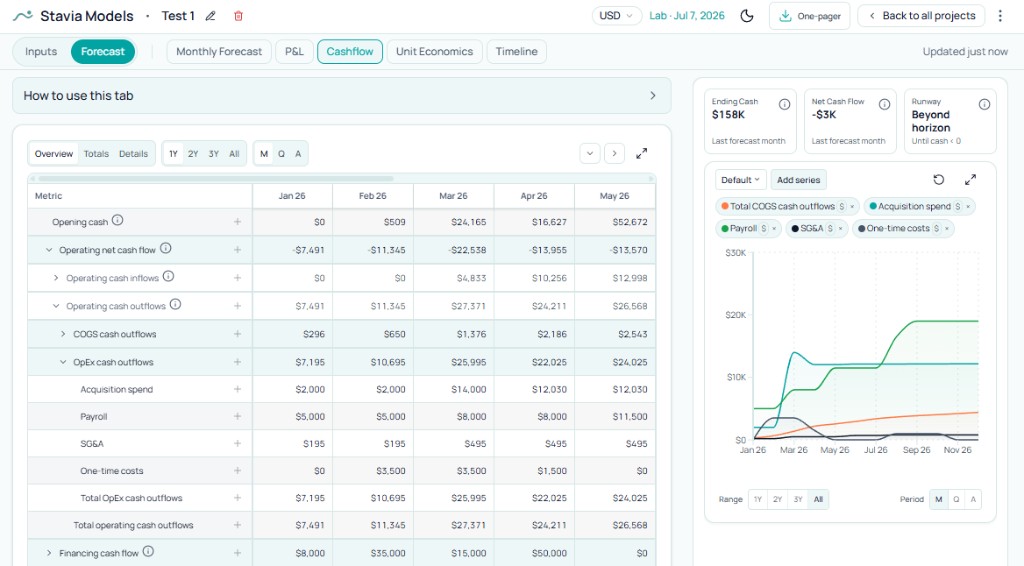
The model should show how much cash the company starts with, how much money is raised, when that money arrives, how much is spent each month, how revenue collections affect cash, when the company reaches its lowest cash point, how much runway the round creates, and whether there is enough buffer. This is why early-stage investor projections should include cash flow and runway, not only a P&L or revenue forecast. See the startup cash flow and runway article and the runway and financing plan.
Unit economics direction
The model should help the founder understand how much revenue comes from each customer, what gross margin looks like, how much acquisition costs, how long CAC payback might be, how churn affects LTV, and whether certain plans, segments, or channels are more attractive than others. For AI products, this section should also connect usage to margin. See the article on startup unit economics.
What makes AI-era projections credible?
Credibility does not come from adding more tabs or making the forecast look precise. A model becomes credible when the assumptions are connected, stage-appropriate, and explainable. A credible model starts from evidence, is driver-based, connects market ambition to bottom-up logic, ties the round to milestones, matches the stage, and stays cost-aware and scenario-aware. The final test is explainability: the founder should be able to explain why revenue grows, why the hiring plan starts when it does, why usage costs stay under control, and why the raise amount is enough.
Common mistakes that weaken investor confidence
Early-stage financial projections often fail because the model tells a growth story without explaining the operating logic behind it.
Investor questions your model should help you answer
A good financial model prepares the founder for a better fundraising conversation. It will not remove uncertainty, but it should make uncertainty visible enough to discuss.
- What have you already tested before this round?
- What exactly will this round help you prove?
- Why is this the right amount to raise?
- How many months of runway does this create?
- What milestone should be reached before the next round?
- Which costs start immediately after funding?
- Which hires are essential, and which can wait?
- What happens if product development takes three months longer?
- What happens if acquisition is twice as expensive?
- What happens if pilot customers convert more slowly?
- How does your market size connect to your revenue model?
- What does AI make cheaper in your operating plan?
- What does AI make more expensive or more risky?
- Which assumption is based on evidence?
- Which assumption is still a hypothesis?
- What would make you change the plan?
- What part of the model creates the biggest risk?
Investors are not only testing the spreadsheet. They are testing the founder's understanding of the business. A model that helps the founder answer these questions clearly is much more useful than a model that only produces a polished revenue chart.
How Stavia helps founders prepare investor-ready projections
Stavia Models is built around the idea that a startup financial model should be a connected decision environment. Founders enter assumptions through guided sections: pricing, acquisition, costs, team, and financing. Those assumptions flow into the monthly forecast, P&L, Cash Flow, Unit Economics, detailed forecast views, runway, and funding need.
This matters for fundraising because investor projections are only useful when the logic stays connected. A pricing decision affects revenue, cash timing, unit economics, and CAC tolerance. An acquisition plan affects subscribers, spend, burn, and payback. A hiring plan affects product capacity, operating expenses, runway, and funding need. AI/API costs affect gross margin, plan design, and free usage limits. For a deeper walkthrough of how forecast views connect, see the article on the detailed startup forecast.
Build investor-ready projections with a connected model
Stavia Models helps founders connect pricing, acquisition, costs, team, financing, P&L, cash flow, runway, and unit economics in one guided workflow. For AI, SaaS, and subscription products, the model also helps founders understand usage costs, gross margin, and funding need before the plan becomes expensive to test.
About the author

Anastasiia Nikolaeva
Founder of Stavia Models
Anastasiia Nikolaeva is a financial modeling consultant and the founder of Stavia Models. She has built financial models for SaaS, AI, marketplace, and other startup business models, helping founders plan pricing, growth, fundraising, and unit economics. Stavia Models is based on this hands-on consulting experience and turns that modeling logic into a guided product.