
How to Model SaaS Pricing Before Launch: Plan Mix, Billing Cadence, Churn, and LTV
Pricing is not just a number on your website. Before launch, it shapes your revenue curve, cash runway, and unit economics. Here is how to model it properly.
Test a pricing scenario
Adjust assumptions and see how pricing changes revenue timing and LTV.
Most founders treat pricing as a go-to-market decision. It is that. But it is also a financial system.
The price you choose, the share of users who land on each plan, the billing structure you offer, and the churn you expect on each option all change the shape of your business. They affect how fast revenue grows, how much cash you collect upfront, how long customers stay, and whether your LTV:CAC ever becomes attractive enough for growth.
Product access choices—trial, freemium, or something in between—can shift when paid subscribers show up as much as headline price points. It helps to model those paths explicitly.
That is why pricing should not live only in a positioning doc or a Notion page. It should live inside the operating model of the company — one layer in a startup financial modeling guide that connects plan mix, acquisition, costs, and runway.
In Stavia Models, pricing assumptions feed directly into subscriber growth, recognized revenue, cash receipts, gross profit, ARPA, LTV, and LTV:CAC. That makes pricing something you can test before launch instead of guessing and fixing later.
Pricing is not one decision. It is a chain of assumptions.
When founders say "we are still deciding pricing," they often mean one of several things: what price to put on each plan, what billing cadence to offer, or what mix of customers they expect to land on each option. Those are different variables, and they affect different outcomes.
In a subscription model, pricing usually includes: plan structure, plan launch timing, plan mix, price points by billing cadence, billing mix, monthly churn, annual non-renewal, and how those assumptions affect revenue, cash flow, and unit economics.
That matters because the model does not simply multiply "customers × price." It first allocates new customers across plans. Then it splits them across billing options. Then it tracks monthly subscribers and annual cohorts separately. Only after that does it calculate revenue, cash inflows, and unit economics.
So the right question is not "what price should we charge?" The better question is:
What pricing structure produces the subscriber mix, cash profile, and LTV profile we actually want?
The five pricing inputs that matter most
1. Plan mix
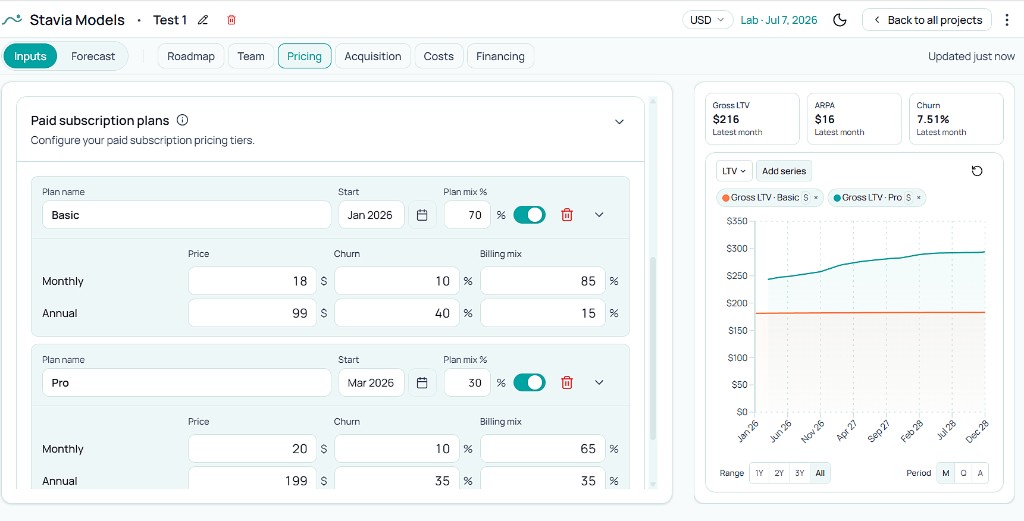
Plan mix is the share of new paid subscribers that goes to each plan. This matters because plan mix changes the weighted average economics of the company. If more customers land on a higher-priced plan, blended ARPA goes up. If that plan also has better retention, blended LTV improves too.
One important nuance: plan mix affects new subscriber allocation. It does not move existing customers between plans. So when you change plan mix in a model, you are changing the future composition of growth, not rewriting the past.
2. Billing mix
Billing mix is the split between monthly and annual billing. This is one of the most underestimated pricing variables. Many founders treat it only as a discount question. In practice, it is also a cash-flow decision. Monthly billing gives you steady recurring cash. Annual billing gives you larger upfront payments and different renewal behavior.
In the model, monthly subscribers generate revenue and cash in the same month. Annual subscribers pay in full upfront, but revenue is recognized gradually over twelve months. Two pricing scenarios can have similar headline ARPA and very different runway.
3. Churn by billing type
Monthly churn and annual churn should almost never be treated as the same thing. Monthly subscribers have more frequent opportunities to leave. Annual subscribers usually have stronger commitment and renew only at the end of the term. If annual churn is lower, a higher annual mix can improve not only cash flow but also LTV.
This is where founders often make their model look cleaner than reality by using one generic churn rate everywhere. That hides one of the most important pricing trade-offs in the business.
4. Plan start timing
A later plan launch changes more than the product roadmap. If your Pro plan starts in March instead of January, it is not just "delayed monetization." It changes the plan mix of all new customers before launch, lowers early blended ARPA, and delays the point at which higher-value customers begin entering the model. That is why plan timing should sit inside the financial model, not outside it.
5. Price points
Price still matters, of course. Higher prices increase ARPA, MRR, and gross LTV. But price does not act alone. Higher prices can change plan mix, alter billing behavior, and in the real world may affect churn and conversion. A useful pricing model should make the direct financial effects visible, then help founders test whether the resulting targets still look achievable.
How pricing assumptions flow through the model
Here is the logic in simple terms.
The number of new paid customers is whatever your acquisition inputs produce—channels, traffic, and conversion—not something the pricing tab invents on its own.
How it flows
- 1The model takes the number of new paid customers coming from acquisition.
- 2It allocates those customers across active plans using plan mix.
- 3It splits each plan's new customers between monthly and annual billing using billing mix.
- 4It tracks the subscriber base: monthly subscribers can churn each month; annual subscribers are tracked in cohorts and renew twelve months later based on annual churn.
- 5Only then does the model calculate outputs: revenue, cash flow, P&L, and unit economics.
Revenue
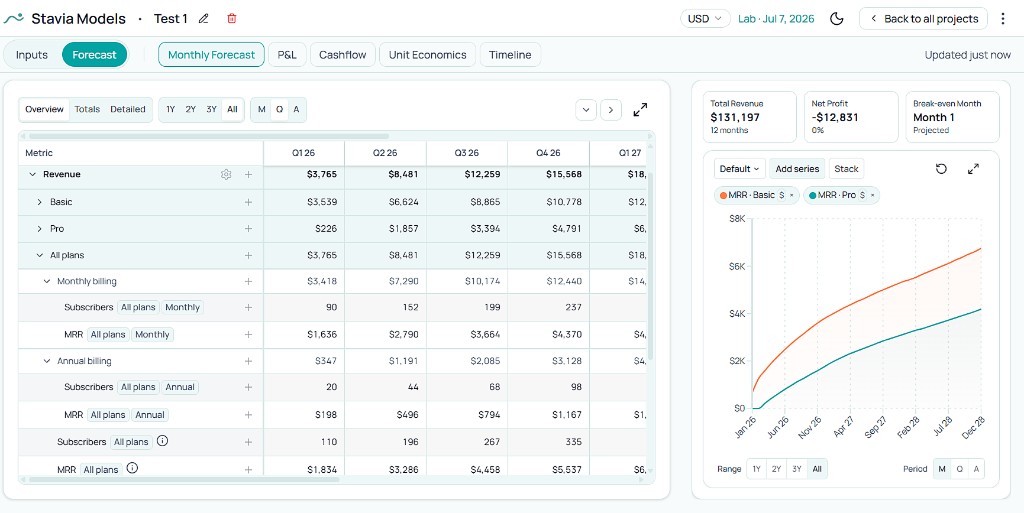
Monthly subscribers contribute monthly recurring revenue based on monthly price. Annual subscribers contribute recognized monthly revenue based on annual price divided across twelve months.
Cash flow
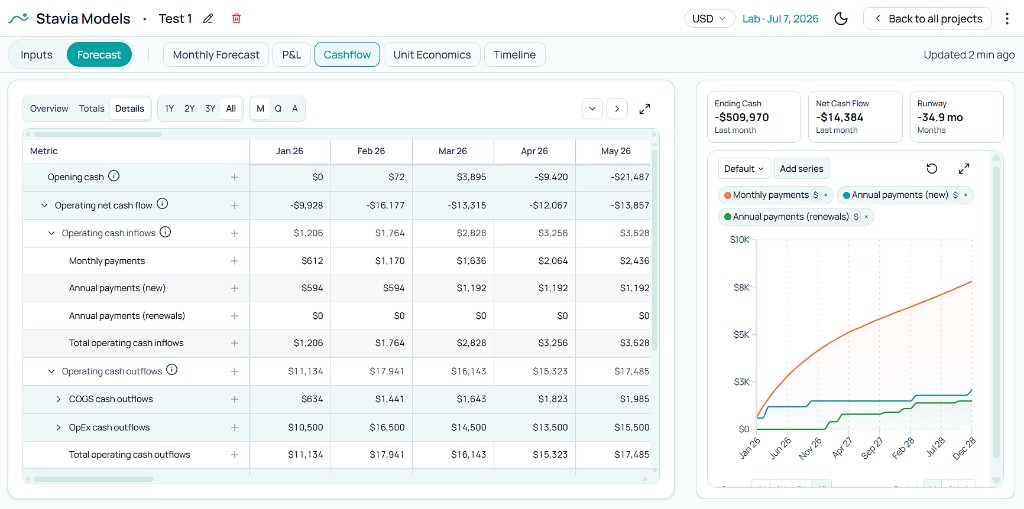
Monthly subscribers pay month by month. Annual subscribers create cash spikes when they sign up and when they renew.
P&L
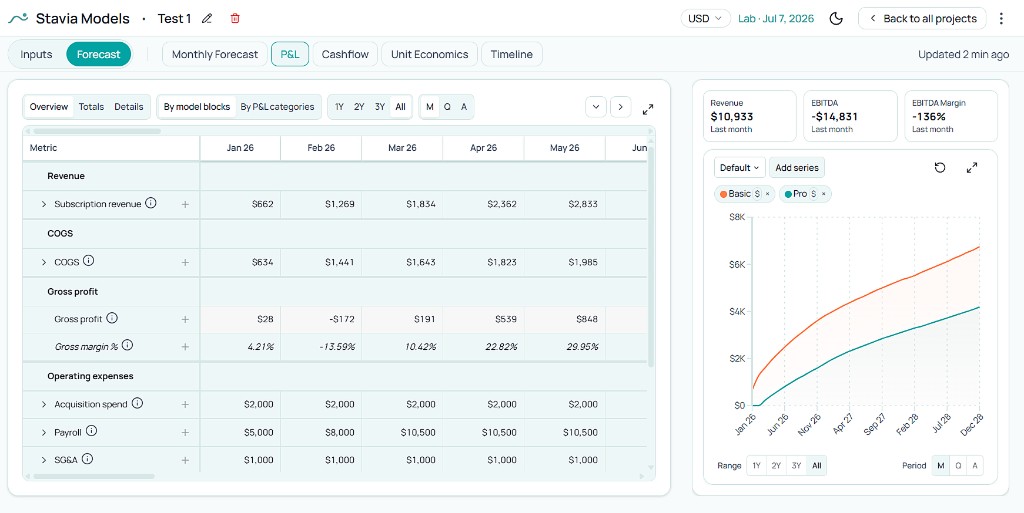
Revenue flows into gross profit and EBITDA after COGS and operating expenses. Higher pricing improves revenue and gross profit.
Unit economics
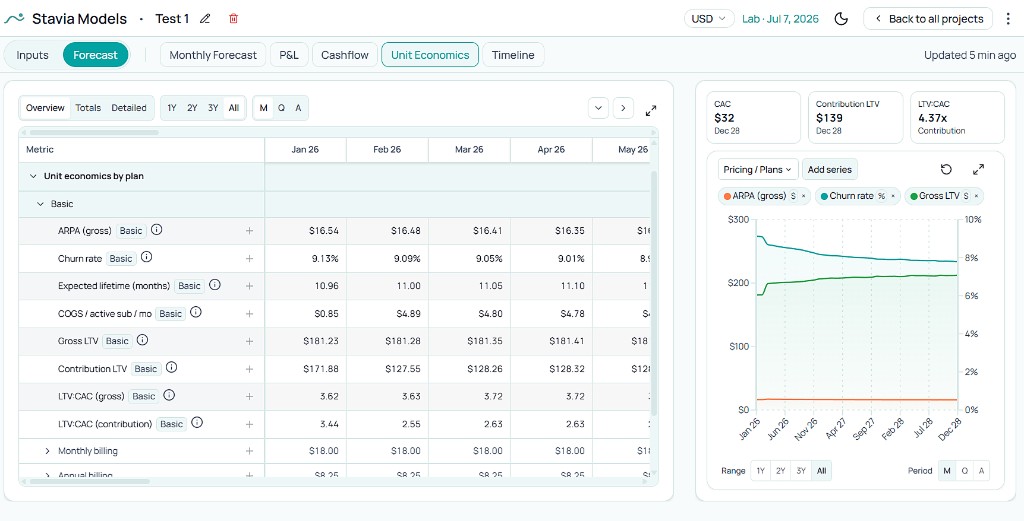
ARPA, expected lifetime, gross LTV, and LTV:CAC are all influenced by pricing assumptions, especially by plan mix, billing mix, and churn. This is why pricing cannot be evaluated just by asking whether the price "feels right" in the market. It has to be tested against business economics.
A practical example: Basic + Pro pricing before launch
Imagine a startup launches with two paid plans. This is an illustrative example; your plan structure may have more tiers or different mechanics.
Basic
- starts in January 2026
- takes 70% of new paid customers
- priced at $50 monthly or $480 annually
- monthly churn 5%, annual churn 10%
- billing mix 80% monthly / 20% annual
Pro
- starts in March 2026
- takes 30% of new paid customers after launch
- priced at $100 monthly or $960 annually
- monthly churn 4%, annual churn 8%
- billing mix 60% monthly / 40% annual
At first glance, this looks like a simple two-tier pricing setup. It is not. Before March, only Basic is active, so it captures effectively all new paid customers. That means early ARPA is lower than the long-term blended ARPA the startup hopes to achieve. When Pro goes live, the economics start to change: more new subscribers enter the higher-price plan, more annual cash comes in because Pro has a higher annual share, and blended churn improves because Pro retains better.
The founder should notice three things immediately: First, delaying Pro lowers early monetization quality, even if total customer acquisition stays the same. Second, the annual share has a bigger effect on cash timing than on recognized revenue in the early months. Third, small churn improvements have an outsized effect on LTV because lifetime expands as churn falls.
Why billing cadence changes cash flow faster than it changes revenue
This is one of the most important pricing lessons for founders. With monthly billing, the business collects cash and recognizes revenue each month. With annual billing, the business collects the full payment upfront but recognizes it gradually across the year. A higher annual share can improve runway even before it dramatically changes reported revenue.
For an early-stage startup, that matters a lot. The same acquisition engine can produce very different financing pressure depending on billing mix. So when founders compare pricing scenarios, they should not ask only: Which one gives us higher MRR? They should also ask: Which one gives us better cash timing? Which one creates stronger renewals? Which one produces healthier LTV?
How pricing decisions show up in unit economics
Pricing affects unit economics through a few main paths.
ARPA
If more users land on higher-priced plans, or more choose annual contracts with stronger effective monetization, blended ARPA rises.
Churn and lifetime
Expected lifetime is highly sensitive to churn. If churn rises, lifetime falls quickly. Since LTV is driven by ARPA divided by churn, even modest changes in churn can move LTV much more than founders expect.
Gross LTV
Gross LTV combines ARPA and expected lifetime. A pricing setup that raises ARPA but also increases churn may not improve LTV. The real question is whether pricing raises durable unit economics. For AI products where usage drives COGS, plan price and included usage should align with the behavior that creates cost — see action-based AI product cost forecasting before you set caps or overage rules.
What KPIs should founders set before launch?
Before launch, pricing should be translated into target operating KPIs. At minimum, a founder should define: target plan mix, target billing share by cadence, expected monthly churn by segment, expected annual non-renewal, target blended ARPA, target gross LTV, and target LTV:CAC range.
These are not "forecast outputs" to observe passively later. They are assumptions that shape the growth model from the beginning. After launch, compare actual performance against those targets: Are too many customers staying on the cheapest plan? Is annual take-up lower than expected? Is churn too high? Is the realized ARPA high enough to support CAC? Read blended LTV:CAC and payback in a startup unit economics model so pricing targets stay connected to acquisition spend.
Pricing strategy becomes much easier to improve when these questions are tracked inside one model instead of across disconnected spreadsheets.
Five common mistakes founders make when modeling pricing
How to use Stavia Models to pressure-test pricing before launch
Inside Stavia, this is the workflow:
- In the Pricing inputs, define your plans, start timing, prices, billing split, and churn assumptions.
- Then go to the forecast views and check what changes: Monthly Forecast shows subscribers and MRR by plan and billing type; Cashflow shows the difference between monthly receipts and annual cash spikes; P&L shows gross profit and EBITDA; Unit Economics shows ARPA, lifetime, LTV, and LTV:CAC.
The goal is not to find a perfect pricing strategy on the first attempt. The goal is to build a pricing system that survives contact with the actual economics of the business.
Pricing before launch is not just a marketing decision or a monetization guess. It is one of the earliest strategic choices that shapes the financial profile of the company. If you model it properly, you can see how plan mix, billing cadence, churn, and price points affect revenue, cash flow, and LTV before those decisions become expensive to reverse. That gives founders a much better way to launch: with a pricing strategy that is not only positioned well, but financially coherent.
About the author

Anastasiia Nikolaeva
Founder of Stavia Models
Anastasiia Nikolaeva is a financial modeling consultant and the founder of Stavia Models. She has built financial models for SaaS, AI, marketplace, and other startup business models, helping founders plan pricing, growth, fundraising, and unit economics. Stavia Models is based on this hands-on consulting experience and turns that modeling logic into a guided product.