
How to Plan Paid Acquisition for an Early-Stage SaaS Before You Start Spending
Paid growth is not one marketing line. Different channels buy traffic differently, and the same budget can mean different subscribers and CAC. Here is how to model paid performance with real timing, CPC and CPM logic, and a test phase before you assume scale.
Test a paid acquisition scenario
Adjust assumptions and see how paid spend turns into subscription revenue over time.
Cumulative ad spend and cumulative subscription revenue over 36 months.
Paid acquisition is easy to flatten into a single line in a spreadsheet: marketing spend rises and the model hopes customers appear. In practice, search, paid social, and a short learning campaign behave nothing alike. The same budget produces different traffic depending on whether you price the buy in CPC or in CPM and CTR, and different subscribers depending on who reaches your site and how the funnel treats them. That is a financial modeling problem, not a media-buying tutorial alone.
This article is about representing that honestly in a startup forecast — especially self-serve SaaS where trials or signups become paid subscribers without a sales team. The useful questions are how many paying users the spend can support at stated conversion, what CAC that implies, whether pricing and LTV can carry it, and what happens to cash if you ramp before the funnel is ready.
For where paid sits next to organic, partners, and referral in the full picture, see How to Model Acquisition Channels for Self-Serve SaaS. Here we go deep on the paid-performance side only.
Why model paid acquisition before you spend
Spend flows into growth, growth into revenue, and marketing into burn. If paid is vague, everything downstream — subscriber count, CAC, runway, hiring — inherits that vagueness. A channel-level model does not need perfect platform data on day one. It needs explicit assumptions you can argue with: budget, how buying works (CPC vs impressions), and how traffic converts through trial or freemium into paid users.
When those pieces are separated per channel, you can compare outcomes in subscriber and CAC terms instead of stopping at cheap clicks. That is the bridge between ad dashboards and board-level questions about whether the business can afford the growth story.
Test first, then scale
One of the most common modeling mistakes is assuming a large, permanent paid budget from month one. Early on you rarely know which channel, creative, or landing story will hold. Messaging, onboarding, and offer are still moving. Locking in scale before you have evidence turns the forecast into a bet dressed as a plan.
A more realistic shape is a limited test window: a few months and a modest budget to learn whether you can reach the right audience, whether traffic converts to trials, and whether trials convert to revenue at a CAC you can live with. In the model, that is simply a channel with an end month. When the test ends, you either turn spend down, reallocate, or open always-on channels that start when you are ready to treat them as ongoing engines.
Scaling is then a decision informed by numbers — not an automatic continuation of the same line you drew before the product had traction.
What you are buying: CPC and CPM in the forecast
A useful paid-acquisition model starts with the same choice a founder or marketer makes in the ad account: what exactly are we buying with this budget?
That is the real reason CPC and CPM matter. They are not labels for "search channels" versus "social channels." They are the pricing logic behind a campaign. In some cases, you want to think in cost per click because the campaign is being judged on the cost of bringing a visitor to the site. In other cases, it is more realistic to start from impressions because the campaign is buying reach first, and clicks depend heavily on creative quality, targeting, and how well the offer earns attention.
That distinction matters in the forecast because it changes where your assumption risk sits. In a CPC campaign, the core question is whether you believe the cost of a visit is realistic and whether that traffic is likely to convert once it lands. In a CPM campaign, you are taking on an extra layer of uncertainty before the visitor even reaches the site: now your creative has to earn the click. If your CTR is weak, the campaign becomes less efficient before your landing page or onboarding flow even has a chance to do its job.
This is why founders should model paid performance one campaign at a time instead of forcing everything into one blended CAC assumption. Search may have more expensive visits but stronger intent. Paid social may bring broader and potentially cheaper traffic, but only if the creative is sharp enough and the landing page is persuasive enough to pull colder users through the funnel. LinkedIn may look expensive on the surface and still make sense if deal value, retention, or expansion revenue are materially better than on other channels.
Once traffic is in the model, the logic becomes more familiar. Visits turn into trials or signups. Trials or signups turn into paying users. But that last part is exactly where many startup models become too optimistic. Founders often reuse the same conversion assumptions across very different traffic sources because it keeps the sheet tidy. In reality, different campaigns deserve different conversion expectations. High-intent search, broad paid social, retargeting, and a temporary experimental campaign should not all be treated as equally warm traffic.
The practical lesson is simple: use CPC or CPM based on how the campaign is actually being bought and managed, then adjust downstream conversion assumptions to match the quality of that traffic. That gives you a much more honest view of paid growth than a single headline CAC number ever will. In the full acquisition picture, paid rows still sit next to what you assume for organic and owned traffic and for partners and affiliates, so blended growth and blended CAC stay traceable. For how trials and signups become revenue on the calendar, see Free Trial vs Freemium.
If you want to source starting assumptions more professionally, use platform-native planning tools first. Google's Keyword Planner describes forecasts that take bid, budget, seasonality, and other factors into account; Performance Planner describes daily-refreshed forecasts that simulate recent auctions and account for variables such as seasonality and competitor activity. LinkedIn's campaign tools surface forecasted spend, key results, and cost per result; Media Planner can help with forecasted reach and impression curves across spend levels. Meta's estimated audience size is a useful sanity check before you lock a social assumption into the model.
A realistic three-channel example
The three-channel setup works best if you read it as a sequence of decisions, not as three neat rows with numbers. Below, the same worked example is shown in Stavia Models so you can see how timing, budget, and buying logic look as concrete inputs next to spend and CAC.
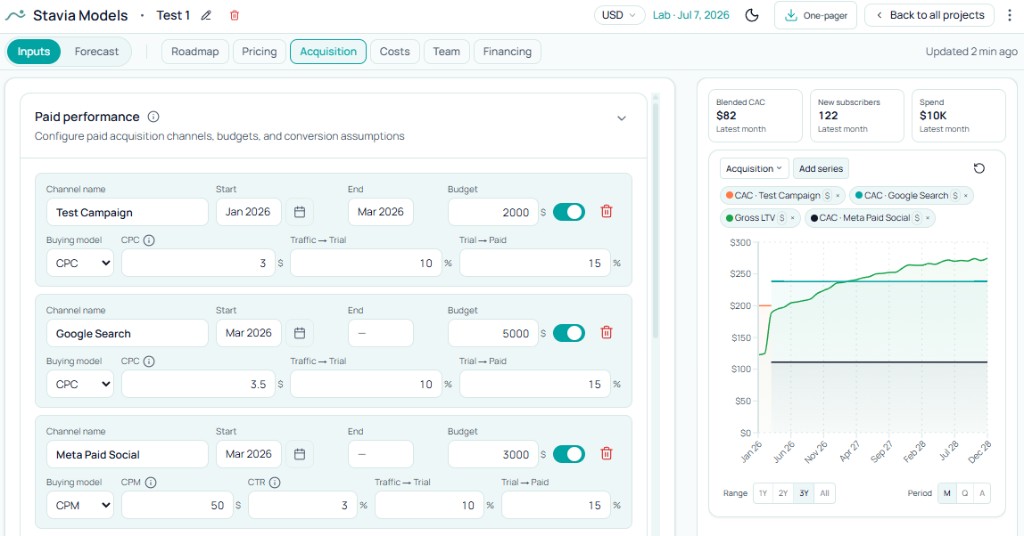
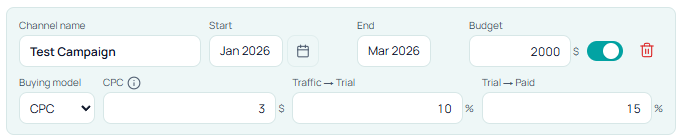
The first row, the Test Campaign, is not there because a founder believes that exact campaign will become a long-term engine. It is there because early-stage teams usually need to buy learning before they can buy scale. In the first months, the real job of paid is often to test message, audience, offer, landing page, and onboarding quality. A temporary budget in the model makes that learning visible. It tells the founder: we are willing to spend real money to find out what deserves a larger line later, but we are not pretending the paid engine is already proven.
That is a much healthier way to plan early paid acquisition. Instead of drawing one permanent marketing line from month one, the model starts with a contained experiment. If the test underperforms, the founder can cut it without pretending the whole growth story has failed. If the test shows a useful pattern, the model already has a natural place to scale what worked.
In the screenshots, the test runs January through March 2026 at about $2,000 per month, CPC near $3, traffic-to-trial 10%, trial-to-paid 15% — on the order of ten paid subscribers a month at those assumptions and implied channel CAC near $200. Your numbers will differ; the point is a visible learning budget, not a permanent line dressed as certainty.
That is why Google Search begins later in the example and remains open-ended. Search often becomes the more predictable baseline paid channel, especially once the team understands what queries matter, what value proposition earns the click, and which landing flow converts best. A founder may accept a higher click cost here if the traffic arrives with clearer intent and turns into more reliable paying users. Search is not always the cheapest channel. Often it is simply the easiest to justify because the traffic is closer to an explicit need.

Meta Paid Social answers a different question. It is usually less about capturing existing demand and more about creating enough interest for the right people to click in the first place. That means the economics live one step higher in the funnel. Budget buys impressions, creative earns attention, CTR turns attention into visits, and only then does the landing experience get its chance to convert. This is exactly why the row belongs in the model as its own logic, not as a copy of the search row with cheaper traffic.

What matters in the example is not which row produces the prettiest CAC in one screenshot. What matters is the conversation the model makes possible. A founder can ask whether search should be the stable backbone and social the second engine, whether the test window is long enough to learn anything meaningful, whether the social row is too optimistic for cold traffic, and whether the higher-volume channel is actually the better business channel once conversion quality, retention, and payback are considered.
That is the real value of showing three rows together. It turns paid acquisition from a vague growth ambition into a set of choices the founder can actually discuss, challenge, and revise.
Public benchmark reports are useful, but only as starting points. For Google Ads, a 2025 roundup based on LocaliQ data put overall average search CTR at 6.66% and average CPC at $5.26. For Meta traffic campaigns, WordStream's 2025 benchmark report found an overall average CTR of 1.71% and average CPC of $0.70 across the campaigns it analyzed. Those numbers help avoid fantasy assumptions; they are not substitutes for account-specific planning.
Why timing fields matter
Timing is where a paid-acquisition plan stops being a media idea and becomes an operating plan.
A start month and an end month may look like small setup fields, but they answer some of the most important founder questions in the model. Are we testing now, or after onboarding improves? Are we planning a short launch push, or an always-on acquisition engine? Are we entering a new geography in one quarter or spreading spend more gradually? Are we putting budget behind a feature release, or waiting until the product and messaging are more stable?
Without timing, all paid spend gets flattened into one smooth line. That usually makes the plan look cleaner than reality. Start and end dates force the founder to be explicit about when risk enters the model. Spend starts affecting burn immediately. Subscriber growth may lag. Revenue recognition lags further still. If the campaign starts before the funnel is ready, the model should show that cost. If a growth push is intentionally tied to a launch or fundraising period, the model should show that too.
Timing is also what keeps paid from quietly overrunning the rest of the plan. A three-month test, a seasonal campaign, and a permanent search program may all look reasonable in isolation. Put them on the same calendar and the cash story can change fast. That is why timing fields are not administrative detail. They are how the founder decides when the company is willing to absorb the risk of paid learning and when it is ready to fund repeatable paid growth.
What fits this modeling style — and what does not
This approach is built for direct-response channels where you can connect spend to traffic and traffic to conversion: search, paid social, LinkedIn ads, many YouTube or display setups if you can state CPM and CTR with a straight face, and similar buys. Creator or influencer spend can sit here when you can translate it into measurable traffic (tracked links, codes, or performance terms). If the spend is mostly awareness with no reasonable path to clicks and trials, forcing it through CPC math will mislead you — better to keep that outside this structure or to model a narrower, measurable slice only.
Broad brand sponsorships, vague partnerships, or anything that cannot be tied to traffic and funnel conversion are a weak fit. The limitation is worth stating plainly so the model stays credible.
How paid flows through the rest of the forecast
Paid performance becomes genuinely useful only when it stops being a traffic story and becomes a company story.
The first effect is obvious: paid spend increases marketing expense. But that is only the beginning. If the channel works, it also increases new subscribers. Those subscribers change revenue, and depending on the business model they may also increase payment fees, support load, onboarding effort, or usage-related costs. So the founder should not read paid rows only through the lens of clicks or even CAC. The real question is whether the company can afford the growth path that paid creates.
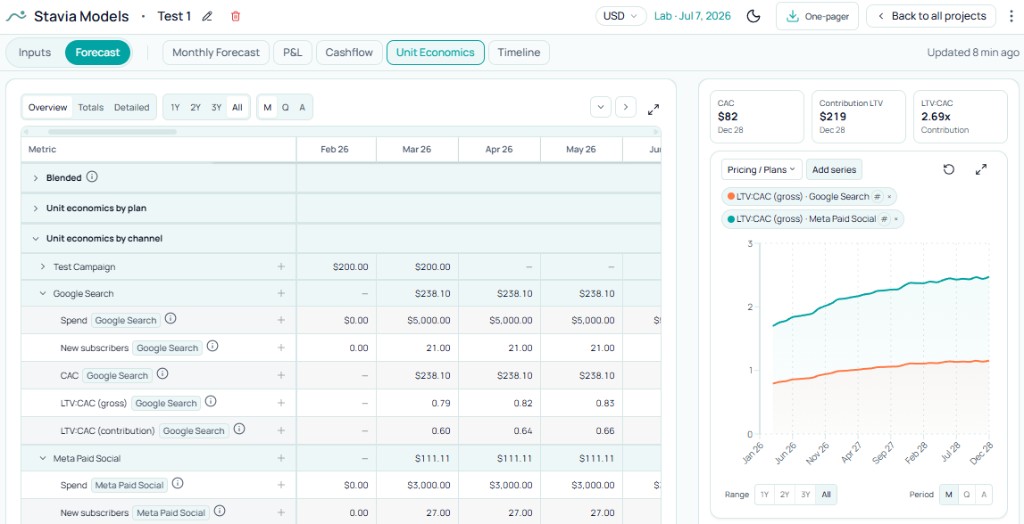
That is where channel-level unit economics matter. A higher CAC is not automatically bad if the users acquired through that channel retain better, expand faster, or generate stronger contribution over time. A cheaper CAC is not automatically good if the traffic is weak, churn is high, or the team cannot scale the channel without performance deteriorating. This is why comparing paid channels only on click cost is such a shallow way to plan. The model should let you compare spend, subscriber volume, CAC, and value creation in one place.
Paid also changes how a founder thinks about runway. A team can destroy cash surprisingly quickly by scaling paid a quarter too early. That does not always show up if the model only asks whether "marketing is growing." It becomes much clearer when the founder can see when the spend starts, how much subscriber lift it creates, how quickly revenue catches up, and whether the business can carry that gap. In that sense, paid rows are not just acquisition assumptions. They are financing assumptions too.
The most useful interpretation of the unit-economics view is not "which channel is cheapest?" It is "which channel deserves more capital?" That is a much more strategic question, and it is the one the model should help answer.
Common mistakes when modeling paid acquisition
How to use Stavia Models for paid acquisition
In Stavia Models, paid acquisition is easiest to build when you treat it the way you would discuss it with a cofounder: one campaign or one channel hypothesis per row.
That usually means separating a short experimental budget from the channels you expect could become ongoing. In Inputs, open Acquisition, then Paid performance. Give each row its own start month, optional end month, monthly budget, and buying logic. If the campaign is easier to reason about from visit cost, model it with CPC. If it is easier to reason about from impression buying, model it with CPM and CTR. Then set the downstream conversion assumptions based on how warm or cold that traffic really is. Rows add up: traffic and spend sum across channels. A blank end month means the channel runs through the rest of the horizon.
The value is not just in entering the rows. It is in reading them back through the rest of the model. Open Forecast, then Monthly Forecast for the time series and Unit economics for spend, subscriber volume, channel CAC, blended CAC, and burn timing. Ask harder questions than how much traffic you get. If a paid plan only works under perfect conversion assumptions, the model should make that obvious before the budget is approved. For trial versus freemium paths, see Free Trial vs Freemium.
This is also where Stavia Models is more useful than a loose spreadsheet note. It keeps the paid-acquisition logic connected to the rest of the company plan, so you are not evaluating campaigns in a vacuum. You are evaluating whether the business can support them.
Conclusion
Paid acquisition should not enter an early-stage forecast as a single growing marketing line.
It should enter as a set of explicit bets: what you are buying, when you are buying it, how that traffic is supposed to convert, and how much capital the company is willing to risk while learning. That is what turns paid from a vague growth ambition into something a founder can actually manage.
The discipline is not to predict paid perfectly. It is to make the assumptions clear enough that you can challenge them before money leaves the account, then tighten them as real data arrives. Founders who do that usually make better decisions not only about channels, but also about pricing, runway, hiring, and how aggressively the company should grow. Those bets sit inside a financial model for startup decisions where acquisition, pricing, and runway share one forecast.
About the author

Anastasiia Nikolaeva
Founder of Stavia Models
Anastasiia Nikolaeva is a financial modeling consultant and the founder of Stavia Models. She has built financial models for SaaS, AI, marketplace, and other startup business models, helping founders plan pricing, growth, fundraising, and unit economics. Stavia Models is based on this hands-on consulting experience and turns that modeling logic into a guided product.