
How to Budget Startup Overhead Without Overbuilding Too Early
Plan recurring overhead and one-time setup costs with the right timing, so your burn reflects the stage your startup is actually in — not a heavier company you may only need later.
See how startup overhead builds by stage
Model recurring overhead and one-time costs with different start points to see how your cost base changes over time.
Recurring overhead
One-time costs
24 months · recurring overhead and one-time stages
Why overhead gets overbuilt too early
One of the most common modeling mistakes is loading month one with too much of the company you expect to have later.
This usually comes from responsible planning. Founders can already see the legal support they will probably need, the broader software stack that will become useful, and the operations layer a larger company requires. The issue is timing. When future structure is treated as current structure, the first stage starts carrying the cost base of a later stage.
That shift quietly changes major decisions. Burn runs heavier earlier, milestone efficiency looks weaker, and the fundraising ask starts supporting a future company before the current one is fully validated. The model then loses one of its most useful jobs: showing what you need now to reach the next milestone with discipline.
The opposite mistake is real too. Some forecasts stay lean for too long and miss the overhead that appears as product and go-to-market execution become more serious. A useful plan does both jobs: restraint early, then staged expansion when the business earns it.
What startup overhead actually means now
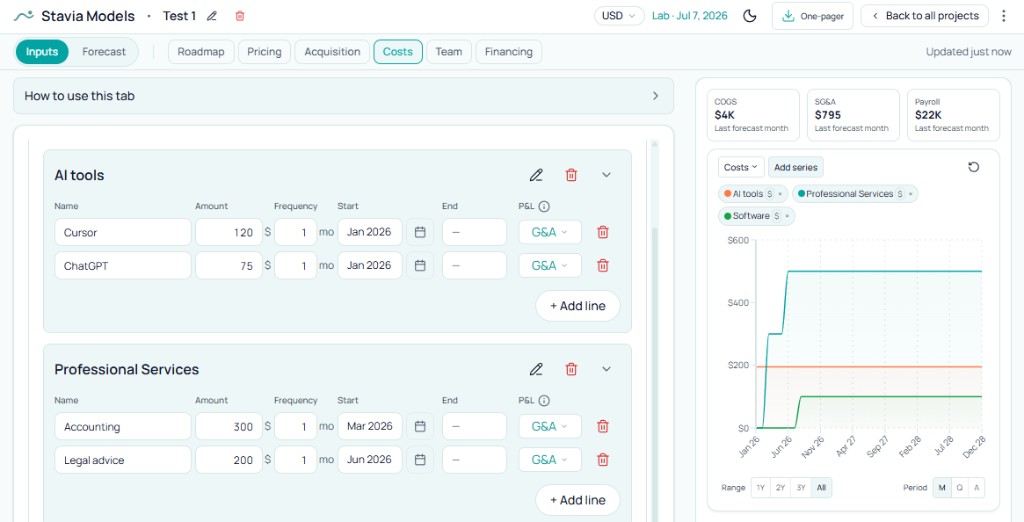
In founder terms, overhead is the recurring non-payroll cost required to run the company around the product. This includes software operations, bookkeeping or finance support, legal and contract support, compliance tools, and the workflow systems that keep the team operational week after week.
The key modeling point is timing and cadence. Overhead is rarely one flat admin line. Some costs start at launch, some start after first customers, some recur monthly, some quarterly, and some stop once a transition is complete.
In Stavia, this is modeled as named recurring lines with amount, frequency, start date, optional end date, and P&L category, so the budget can stay detailed for planning and still roll up cleanly for reading.
What is really essential in the first stage
Most modern early-stage startups do not need an office-heavy operating base to launch. They still need a real operating base, just a narrower one.
In practice, the first layer is usually a selective mix of collaboration and delivery software, basic bookkeeping or accounting support, contract and legal support before commercial activity expands, one or two core workflow tools, and AI subscriptions that replace manual work in the earliest stage. These are operating tools with direct stage value, not placeholders for a future org chart.
A useful test is straightforward: does this cost improve execution quality, operating control, or milestone speed right now? This framing keeps the forecast disciplined without pretending the company can scale forever on a tiny back office.
Remote teams, global payments, and AI tools
Remote-first operation has removed some classic overhead defaults, especially office rent in the first stage. It has not removed overhead itself.
Distributed teams often create a different operating layer: contractor payment tools, employer-of-record services, cross-border payroll operations, and compliance workflows across jurisdictions. For many founders in 2026, these are baseline execution tools rather than edge cases. Platforms like Deel and Remote exist because this overhead profile has become normal for distributed startups.
AI subscriptions are also part of that modern baseline. Coding agents, research assistants, support copilots, and workflow automation can reduce early hiring pressure and increase throughput. They should be budgeted as real recurring operating spend, with the same discipline as any other line, instead of accumulating as invisible "small" subscriptions. When AI compresses launch, validation spend and usage COGS often move earlier than classic overhead planning assumes — see how to build a startup financial model when AI lets you launch faster for how the first 30–90 days change burn allocation. For post-MVP validation burn in the same window — usage, support, and conversion before payroll scales — see how to model an AI MVP built in days. When variable AI spend tracks user actions, action-based AI product cost forecasting belongs in COGS planning alongside overhead — not buried as a generic tool subscription.
What should usually come later
Overhead should scale with business complexity, not with founder anticipation.
As the company grows, deeper finance support, broader legal support, more specialized compliance, a richer software stack, and more mature operating systems become reasonable. Those costs are real. They become dangerous only when they are booked before the stage that actually requires them.
A cleaner plan adds later-stage overhead when there is a concrete trigger: broader go-to-market motion, team expansion, entry into a new region, higher customer support load, or preparation for a more mature operating cadence.
Why one-time costs need their own place
Setup and transition work should stay visible as bounded spend, not disappear into recurring overhead.
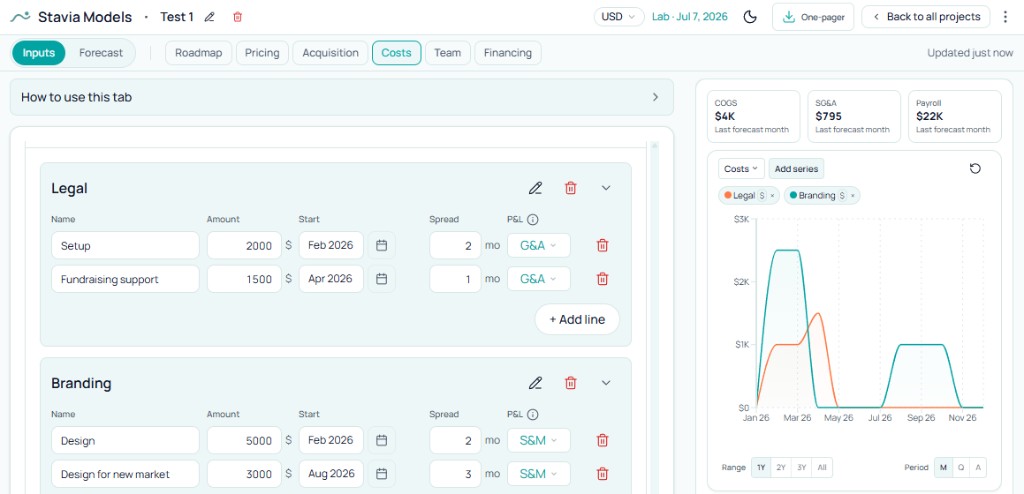
Incorporation support, launch work, branding projects, implementation help, fundraising support, and market entry tasks are all real costs. They matter for cash planning, but they do not define the permanent monthly run rate.
In Stavia, one-time lines are separate from SG&A and include total amount, start month, spread in months, and P&L category. The total is allocated evenly across the spread period, which keeps temporary work visible without inflating the steady operating base.
How roadmap and milestones help with timing
The best timing for overhead is rarely "now" or "later." It is "when the next milestone starts."
If you expect heavier legal support around a raise, additional compliance for expansion, or broader software operations once team size doubles, those costs should begin at those moments in the forecast. This is what keeps stage-based burn honest.
Recurring lines with start and optional end dates, plus one-time lines with bounded spread windows, give you a practical way to model staged overhead without flattening the company into one permanent monthly number.
How this shows up in burn and in higher-level P&L categories
Recurring overhead and one-time costs sit below gross profit. They do not change COGS or gross margin directly; they shape operating burn, runway pressure, and fundraising need.
For founders, this distinction changes how performance is interpreted. A company can have healthy product-serving economics and still run short on runway if operating structure arrives too early, if temporary setup spend is treated as permanent, or if staging assumptions are too optimistic.
Read this first through burn dynamics. A monthly forecast is useful because it shows when overhead steps up, where temporary cost spikes hit, and which assumptions are responsible. That is what lets you stress-test timing before it becomes a cash problem.
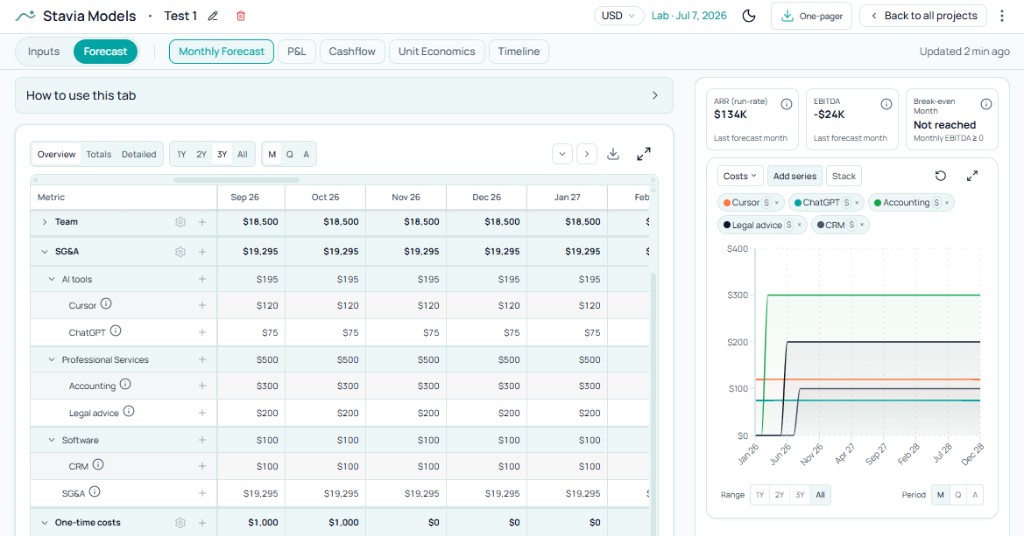
Then read the same business through operating categories. Detailed line items are where founders plan and pressure-test decisions. Higher-level P&L categories are where founders summarize and communicate the company in investor language.
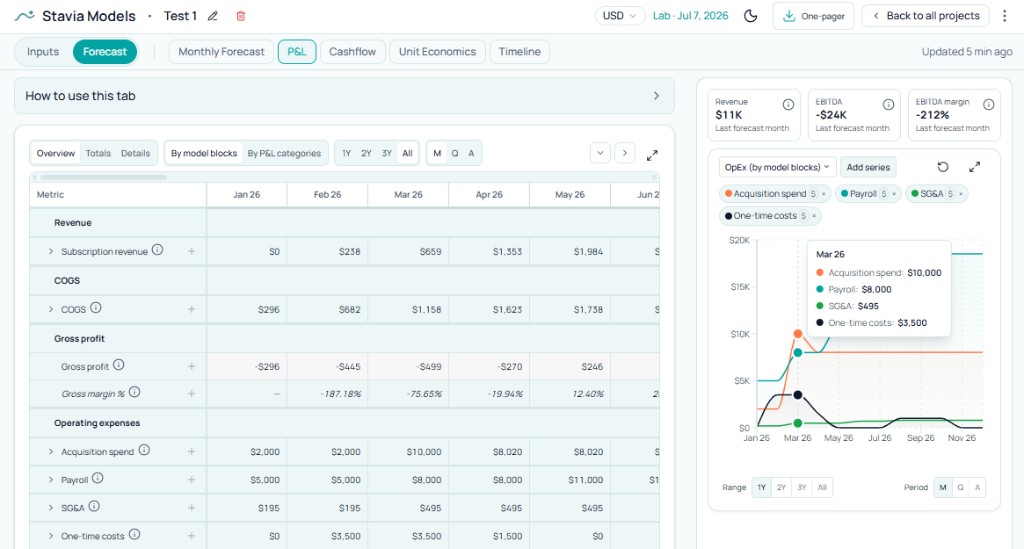
In Stavia, recurring overhead and one-time lines can map to Sales & Marketing, Research & Development, General & Administrative, or Unassigned. That avoids a common distortion: software, legal, or admin lines do not always belong in G&A. A tool that supports product work may map to R&D. A workflow supporting go-to-market execution may map to S&M. Line-item detail improves planning quality; category mapping improves interpretation and communication quality.
This dual view is what makes fundraising conversations stronger. You can show disciplined operational detail and still present the company in clean P&L categories without losing the underlying logic.
How to organize this in Stavia
A strong workflow is simple and stage-driven.
1) Start with recurring overhead. Add real line names, cadence, start month, optional end month, and P&L category so the monthly base reflects how the company actually operates at this stage.
2) Add one-time costs separately. Use total amount, start month, spread period, and P&L category for setup or transition work that should stay bounded.
3) Keep COGS, Team, and Acquisition in their own layers. This preserves margin logic, hiring logic, and growth logic instead of blending everything into one overhead block.
4) Read the outcome through forecast and P&L. Forecast tells you when burn changes and why. P&L categories tell you how the operating story reads at summary level.
For broader context on cost layers around this overhead workflow, see the full early-stage cost-structure guide.
Common mistakes
Conclusion
A staged overhead plan is one of the clearest signals of founder discipline. It shows what belongs now, what belongs later, and what should stay temporary.
That clarity improves more than budgeting. It makes burn logic more credible, strengthens fundraising narratives, and helps teams discuss trade-offs with shared assumptions instead of broad expense guesses.
Keep the model lean where the stage is lean, realistic where complexity is growing, and explicit about recurring versus one-time spend. That is how overhead planning stays honest as the company scales. Overhead timing is one input in a SaaS and AI startup financial model that connects costs, payroll, and runway.
About the author

Anastasiia Nikolaeva
Founder of Stavia Models
Anastasiia Nikolaeva is a financial modeling consultant and the founder of Stavia Models. She has built financial models for SaaS, AI, marketplace, and other startup business models, helping founders plan pricing, growth, fundraising, and unit economics. Stavia Models is based on this hands-on consulting experience and turns that modeling logic into a guided product.