
Free Trial vs Freemium: How to Choose and Model the Right SaaS Access Strategy Before Launch
This is not just a growth tactic. Your access model shapes how users enter the product, how quickly they convert, and when revenue starts to appear.
Compare an access model
Same acquisition, different path to paid.
Trial creates a faster path to paid.
When founders discuss monetization, they often jump straight to pricing.
But before pricing does its job, users still need to reach the paywall somehow. Keeping acquisition assumptions explicit by channel makes that top of funnel easier to sanity-check.
That is where the access model matters. A free trial and a freemium model can attract the same audience and still create very different businesses. One can push users toward faster conversion. The other can build a much larger active base before revenue begins to show up. The difference is not only strategic. It changes the funnel, the timing of new subscribers, and the shape of early revenue.
That is why this decision belongs inside the model, not only inside product or growth discussions. Trial and freemium paths are one part of a broader SaaS financial model framework that connects access, pricing, acquisition, and runway.
In Stavia Models, the access model sits before paid pricing logic. Trial mode and freemium mode create different paths to new subscribers, and those differences flow into the forecast.
What the market actually does
The market is more mixed than the usual startup debate suggests.
Some products keep a real free layer because early adoption is part of the product strategy, not just a lead source. Figma's pricing keeps a free Starter path and free view/comment access on all plans. Linear keeps a Free plan with unlimited members but limits teams and usage. Jira also keeps a Free plan for smaller teams. In all three cases, the product becomes more valuable once people are already inside the workflow, so free access helps the product spread before procurement or formal budgeting catches up.
Other products use trials more deliberately to push users toward evaluating the paid experience itself. Miro combines a permanent Free plan with a Business trial. Sentry gives new accounts a free Business trial before they fall back to the free Developer plan. Loom does something similar by keeping a limited free Starter plan while presenting "Try for free" on Business. These are useful examples because they show a more precise logic: free access can widen adoption, while trial is used when the company wants users to experience the fuller version before making a buying decision.
HubSpot is useful for a different reason. Its free CRM tools are explicitly positioned as free with no expiration date. That only makes sense because a growing free base still creates strategic value: data, workflow adoption, and a future path into paid hubs later.
When freemium fits better
Freemium is strongest when using the product is already valuable before paying for it.
That usually means three things are true. First, a user can reach useful value without a long setup. Second, the free version is good enough to create habit or collaboration, but limited enough that serious usage still points toward paid. Third, a free user still matters strategically even before they convert.
That is why freemium shows up so often in workflow and team software. Linear's free plan lets whole teams get started, but caps teams and usage. Figma gives users a real entry point, while reserve seats and deeper collaboration/admin capability sit in paid plans. Jira's free plan also works this way: enough access to adopt the workflow, but clear limits that eventually force a choice. These are not "give everything away" models. They are controlled adoption models.
Freemium is usually the better launch choice when the founder wants to learn from usage first: who activates, who comes back, who invites others, and whether the product can become part of a workflow before monetization does the heavy lifting.
When free trial fits better
Trial works better when the paid product is the clearest version of the value proposition.
That usually happens when a limited free tier would hide the real strengths of the product, slow down evaluation, or give users enough access to postpone the buying decision indefinitely. In those cases, the company wants the user to experience the fuller version early and then decide.
SaaS companies often use this pattern when premium functionality is the point. Miro's Business trial is built around exposing users to the more complete paid environment. Sentry starts new users on a free Business trial and only then drops them to the free Developer plan if they do not upgrade. Jira Premium also offers a trial path on top of the permanent free plan. Loom's Business plan is presented with "Try for free," which makes sense for a product where the difference between casual free use and serious team use is easier to understand in the paid environment itself.
Trial is usually the better launch choice when the founder wants a faster commercial signal: not just whether users show up, but whether they are willing to move toward paid once they have seen the real product.
Quick chooser
Start with freemium when users can get value quickly, the free layer helps spread or habit, and you are comfortable waiting longer for paid conversion.
Start with trial when the paid experience is where the real value shows up, the evaluation window is naturally limited, and you want a faster signal on willingness to pay.
This is the practical difference founders should model before launch.
Freemium vs trial at a glance
| Dimension | Freemium | Free trial |
|---|---|---|
| Path to paid | Traffic → free signups → active base → paid | Traffic → trials → paid |
| Time to first paid | Delayed; conversion from existing base | Fast; within trial window |
| Free-user base | Grows over time; some churn before paying | None; trials convert or expire |
| Revenue timing | Slower ramp; monetization more gradual | Earlier visibility; cleaner first-year shape |
B2B and B2C are not hard rules
The better lens is how the product gets adopted.
Some B2B products behave like freemium products because adoption spreads across a team before anyone treats the purchase as a formal buying process. Linear, Jira, Figma, and HubSpot's free CRM all fit that logic in different ways: the free layer gets people into the workflow, and the upgrade happens later when limits, scale, governance, or coordination start to matter.
Other B2B products behave more like trial products because the core question is evaluation, not spread. The user needs to see the fuller version, try the serious features, and decide whether it is worth paying for now. Sentry, Miro Business, Loom Business, and Jira Premium are all useful references here because they give access to a more complete paid experience inside a defined window.
So for founders, the practical question is simple: does this product get stronger when more people use it before paying, or when users are pushed earlier into evaluating the paid version?
How to model free trial vs freemium in a financial model
This choice should appear in the model before paid pricing logic begins, because it changes how users move through the funnel before they ever become subscribers.
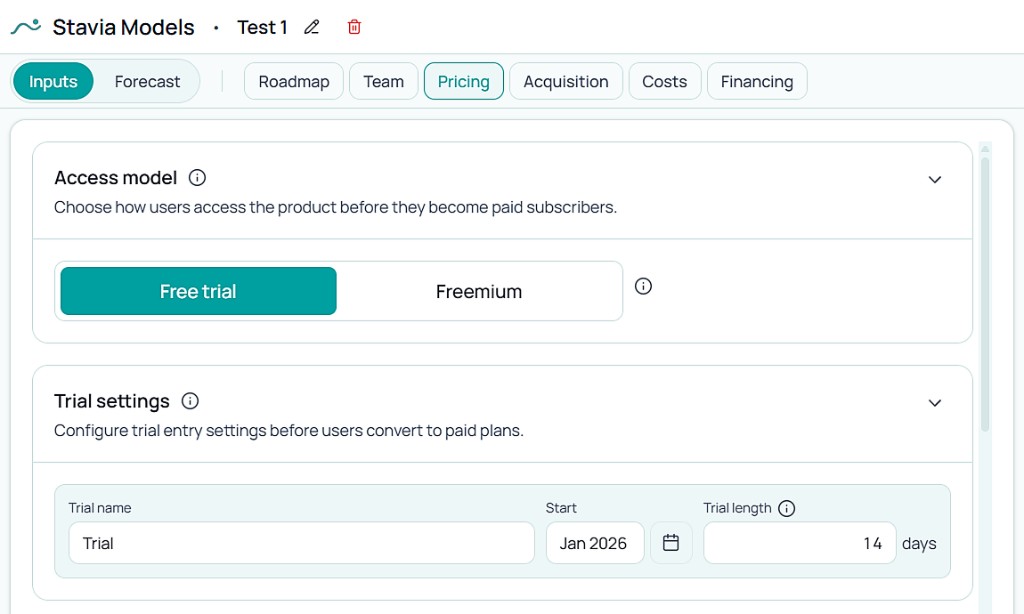
A trial-led model is usually the more direct path. Traffic or signups turn into trials, and then a share of those trials becomes paid. The key question is how quickly that conversion happens and how much of the trial volume turns into actual subscribers.
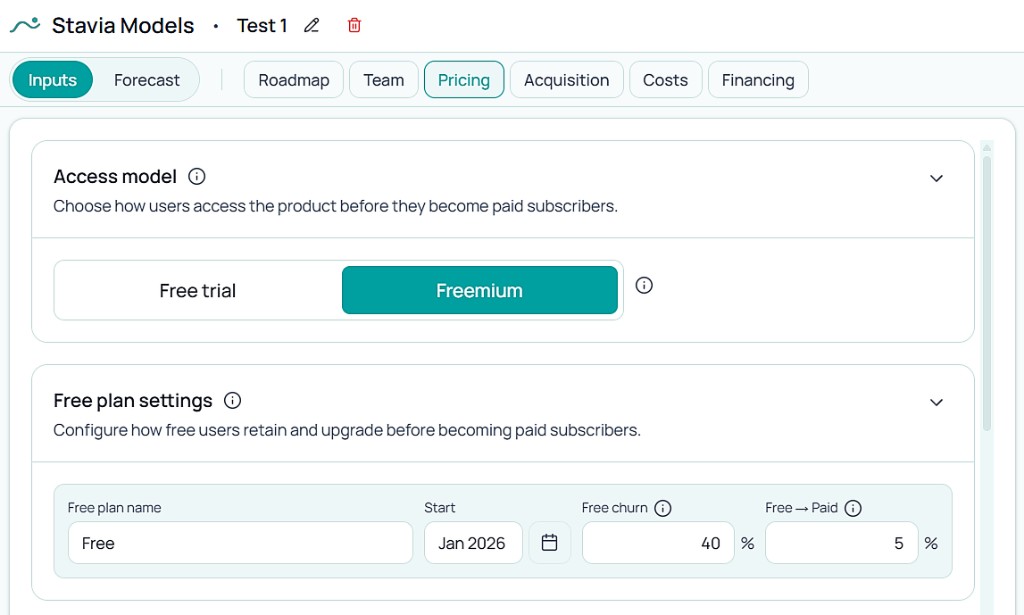
A freemium model is structurally different. Traffic turns into free signups first, then the business starts building a free-user base. From that base, some users convert to paid over time and some churn out before ever paying. That means the model needs to reflect stock as well as flow: not only how many users arrive, but how many remain active long enough to convert later.
That difference is why trial and freemium can produce very different paid-subscriber timing even with the same top-of-funnel volume. Trial usually creates a faster and cleaner path to paid. Freemium usually creates more delayed conversion because the free-user base has to build first.
In Stavia Models, you can see this difference directly. Trial mode focuses on trial starts and the path to subscribers. Freemium mode shows free signups, free-user stock, free churn, and the conversion from free to paid. The screenshots below illustrate that logic inside the product, but the underlying modeling principle is broader than Stavia itself: one path converts from a bounded evaluation window, and the other converts from an accumulated user base.
After someone becomes a paying subscriber, plan mix, billing cadence, and churn by segment determine how ARPA, cash timing, and LTV evolve—separate from the access path that got them there.
Example: same traffic, two very different outcomes
Imagine the same product launches both paths with the same acquisition volume.
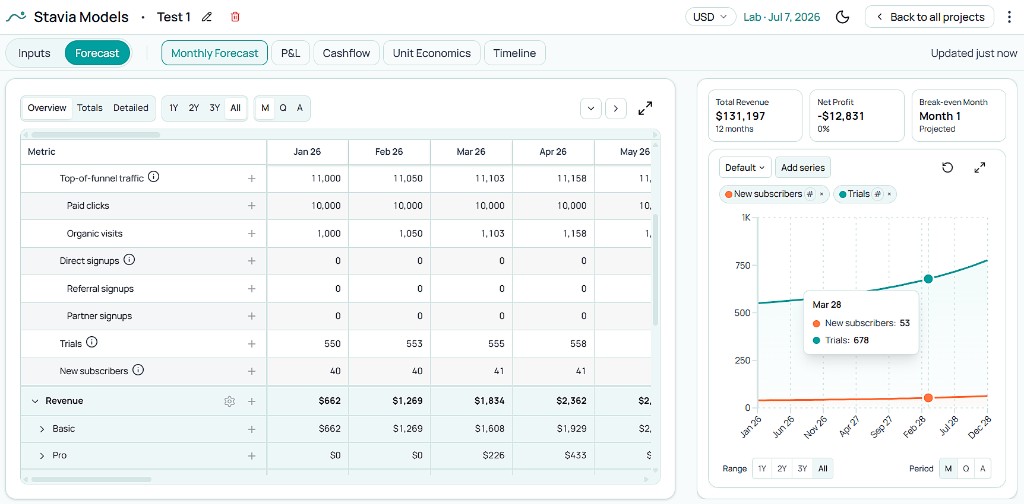
In the trial version, 500 users start a trial each month, 10% convert, and the trial lasts 31 days. That gives the company a relatively quick read on paid conversion. Subscriber creation starts early, the funnel is easier to interpret, and the team gets a faster answer to the question that matters most at launch: do enough users become paying customers once they have seen the product?
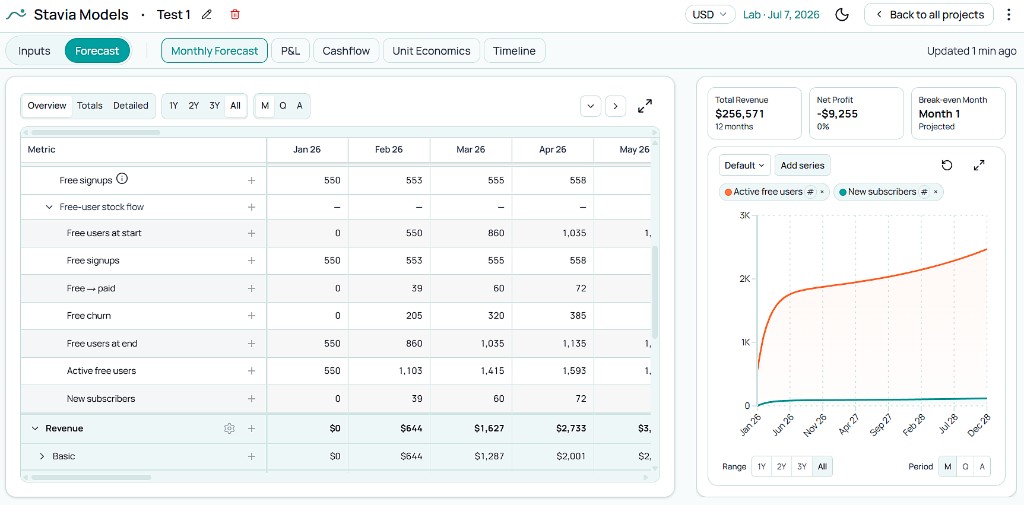
In the freemium version, the same 500 users enter a free plan each month, 5% of the beginning free base converts to paid, and 30% of the remaining free base churns. This path is slower to monetize, but it builds a real asset in the middle of the funnel: an active free-user base. If that base remains healthy enough, it can generate a steadier subscriber flow later than the trial path, even though the start looks weaker.
That is why this choice belongs in the model. Trial usually gives a faster signal. Freemium can produce a larger conversion engine later, but only if enough users stay active long enough to convert.
What founders should actually compare before launch
This choice becomes much clearer when you compare the right KPIs.
For a trial-led launch, the key questions are: how many users start the trial, how many convert to paid, how quickly revenue begins, and whether the trial is creating enough qualified paid subscribers.
For a freemium-led launch, the key questions are: how many free signups enter the product, how quickly the free base grows, how much of that base converts to paid, and how long it takes before the free layer starts producing a meaningful paid flow.
In practice, the most useful comparison points are: time to first paid conversion, new subscribers by month, active free users or trial starts, and 12-month revenue shape. For contribution, payback, and LTV:CAC quality across paths, compare both access models in a startup unit economics model before you commit to one funnel shape.
For AI products, add one more comparison: how much variable serving cost builds up while users are still on trial or a free tier. That cost sits alongside conversion timing, not after it — see how to forecast generative AI API costs before launch, action-based AI product cost forecasting when usage varies by user action, and how to model an AI MVP built in days for post-MVP validation economics when launch moves faster than a long pre-launch build.
Common mistakes founders make
How to compare free trial and freemium
The easiest way to pressure-test this decision is to model both options with the same traffic assumptions.
- In Stavia, set the access model to free trial and review trial-driven subscriber creation.
- Then switch to freemium and review free signups, free-user stock, and free-to-paid conversion.
- Compare how fast new subscribers appear.
- Compare how different the early revenue curve looks.
- Decide which path fits your product better.
This is where a model is useful. It turns a broad product debate into a concrete startup decision.
Free trial and freemium are not just different onboarding choices. They are different economic paths into the same paid product. One usually creates a faster route to paid. The other usually creates a wider base and a slower monetization curve. Neither is automatically better. The right choice depends on the product, the user journey, and the kind of launch you want to support.
If you model both paths before launch, you can see the trade-offs early — before they become expensive to reverse.
About the author

Anastasiia Nikolaeva
Founder of Stavia Models
Anastasiia Nikolaeva is a financial modeling consultant and the founder of Stavia Models. She has built financial models for SaaS, AI, marketplace, and other startup business models, helping founders plan pricing, growth, fundraising, and unit economics. Stavia Models is based on this hands-on consulting experience and turns that modeling logic into a guided product.